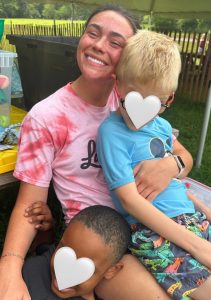
 When I first walked onto the grounds at Camp Lakeside, I thought I understood what “inclusion” meant. I’d read about it in textbooks, discussed it in classes, nodded along in lectures about equity and access. I did not understand it. Not really. Not until I spent my days alongside campers ages seven to twenty, all with different abilities, different ways of moving through the world, different ways of telling me who they were.
Camp Lakeside serves children and young adults of all abilities, and my job, on paper, was to support programming, help run activities, and be an extra set of hands wherever the day needed one. In practice, my job became something much harder to put into a job description, paying attention, really paying attention. To the camper who communicates through a device instead of speech, and who lights up the exact same way anyone does when you actually wait for their answer instead of rushing to fill the silence. To the small shift in a kid’s behavior that tells you a transition is about to be hard before it happens. To the parents who drop their children off each morning carrying a particular kind of hope that today will be a good day.
I won’t pretend every day was easy. Some days things felt completely out of my reach, unsure if I was helping or getting in the way, second-guessing whether I was doing right by the kids I was there to support. But the challenge itself has been some of the best teaching I’ve received in any college course. It forced me to slow down. It forced me to ask instead of assume. It forced me to notice how much of “normal” is really just a narrow definition that most of us happen to fit inside, and how much work and joy there is in building spaces where that definition gets wider.
This experience has sat right in the middle of the questions I came into this fellowship still attempting to answer, questions about purpose, about calling, about what kind of work actually feels like mine. I used to think “purpose” would announce itself clearly, like a sign lighting up over one specific career path. What I’m learning instead is that purpose might be less about a title and more about an attitude. A willingness to show up, pay close attention, and let people teach you who they are rather than deciding in advance who they should be. Camp Lakeside has been full of people doing exactly that: staff who’ve been there for years and still approach every camper with curiosity instead of routine, supervisors who model patience in a way I want to carry with me long after this summer ends.
I think what surprised me most is how much of this work is really about advocacy in small, unglamorous moments — repeating something a camper said so the group hears it, adjusting an activity on the fly so no one is left watching from the sidelines, noticing who hasn’t been asked their opinion yet and asking them. None of it looks dramatic. All of it matters.
I came to this internship hoping to learn something about disability, equity, and camp programming. I’m leaving it having learned just as much about myself, how I listen, where my patience runs thin, what it looks like to advocate for someone quietly and consistently rather than loudly and once. I don’t think I’ve arrived at an answer to what my “calling” is. But I think I understand a little better what it feels like when the work you’re doing is actually asking something real of you. Camp Lakeside has asked a lot of me this summer. I’m grateful for every bit of it.
Grace Vaughn, Camp Lakeside
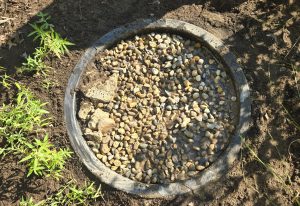 Being about 6 weeks into interning at Save the Dunes, I have further integrated myself into the experience and have had so many highlights that have shaped me this summer. In any environment, it can be difficult to pinpoint where you might fit in, like one puzzle piece out of a thousand fitting into its correct place. This was something that had been on the back of my mind before having acclimated to my new environment. I thought that being in a workplace environment, I had to have one specific role. I have realized, though, throughout my experience, I don’t necessarily need to have “my place”; I can have many, and this is something that I have extensively enjoyed. One of my favorite aspects of my internship has been this kind of discovery. I have been offered several different opportunities, a number of opportunities to assist on projects that are not all one and the same. Working on projects that touch on a variety of different spheres allows me to use and develop skill sets across a wide field.
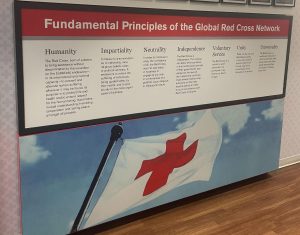 When I first applied for the CAPS Fellowship, I wasn’t just hoping to gain experience for my