Members of the community of Yorkin, on a canoe of the STIBRAWPA association. Photo used with permission from https://enstibrawpayorkin.wordpress.com/images/
I have seen a saying around campus in the past few weeks, in the Student Life Administration window, in the Valparaiso University Center for the Arts Box Office: “Fall is proof that change is beautiful.” It’s true, fall is beautiful. However, I was thinking that perhaps we need the reminder by way of a catchy saying because we don’t often feel that change is beautiful. In fact, it can be downright scary.
Everywhere I turn, people are reflecting on change. The Institute’s Listening for Purpose podcast Season 2 Episode 2, an interview with Valpo senior Reahlyn Bryce (which was released on November 12, 2024), is all about change and beauty in inspiring songs. Reahlyn and Listening for Purpose host, senior Simeon Klepac, discuss the impending transition facing seniors as they finish out their time at Valpo and make plans for the future.
Whenever I attend higher education conferences, colleagues discuss changes on their campuses that make the future uncertain and require adaptation. A change in national administration always brings uncertainty, and many people from all sides of the political spectrum expect the upcoming administrative change to be paradigmatic.
How do we discern our calling and vocation in such times of change and uncertainty? How will our calling change in the impending future? Does impending change bring us hope? Fear? Is the change one that we wanted, or one that was forced on us? Does it bring us deep happiness, or is it full of sadness and regret?
For many people, the question of vocational transition is not merely intellectual or emotional, but real and material to their lives.
During the height of the Covid-19 pandemic, I wrote about women that I know in Costa Rica and Northwest Indiana who responded to uncertainty and crisis with creativity and grit that opened up new possibilities for their families and communities, despite great hardship. The loss of tourism income, the decline of fish populations for island dwellers, the need to take a step back from college – all were setbacks, but the vocational resilience of these women made survival possible for their families.
I want to sit with the stories of so many who have gone before us, who have passed through intense and frightening times, and who survived, even when many others didn’t. From American Indians in my home state of South Dakota that survived boarding schools and are still here today, to refugees who passed through the Darien Gap after leaving behind everything they once knew; from Black Americans who migrated to the North during the Great Migration to escape Jim Crow, to individuals with health diagnoses that set them on vocational paths they would never have chosen for themselves. All of these folks lived a vocation of survival and resilience in the face of change, and forged paths forward.
When economic and political systems are in upheaval, changes and uncertainty affect us all, and we are called to consider how our vocations meet the specific moments we find ourselves in. Big changes mean that our vocations are going to shift, and we may or may not find deep happiness in that transition. Deirdre Egan-Ryan, Professor of English and Director of faculty development at St. Norbert College recently wrote for the Network on Vocation in Undergraduate Education blog: “Even if we don’t want to admit it, we can all feel some degree of fear as our vocations shift. It’s natural for transitions to be times of uncertainty, sometimes so intensively that we fear losing our very sense of self in the process. This is especially acute when changes are ones that we did not choose and that feel out of our control.”
Despite the fear that can come with change, new vocations are also opportunities. In the ILAS student staff read this year, Your Calling Here and Now by Gordon T. Smith, the author encourages us to face questions of change and vocational discernment with an intentional thoughtfulness. Smith describes this thoughtfulness as “critical, confident, creative, and compassionate” (p. 82): we see past the hype (critical), we speak for ourselves (confident), we are capable of adaptability (creative), and we have empathy for others (compassionate). These are postures that we can intentionally practice in moments of uncertainty, and will help us to move forward.
In her podcast interview Reahlyn Bryce reminds us that change and transition are a part of life, as fearful as uncertainty might make us. She reminds us that we will not be able to accept the gifts of a new future if we cling too tightly to the past. May we all, in times of change, embrace the vocation of moving forward.
The Institute for Leadership and Service, we are currently accepting applications to our summer fellowship program called the Calling and Purpose in Society (CAPS) Fellows Program. This is an opportunity to live out a calling in the moment, but also to practice the steps of discernment and deep listening, to learn about situations in the world that require attention and response. The experience will prepare students to approach future issues of calling and purpose with tools of reflection, community, and a responsive attitude.
If you or someone you know are interested in the CAPS Program, you can find more information on our website (www.valpo.edu/ilas), or write to us at lead.serve@valpo.edu.
-by Deaconess Kat Peters, M.Ed., M.A., Assistant Director of the Institute for Leadership and Service
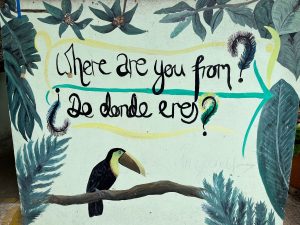 I would like to invite you into a journaling activity this week. We at the Institute for Leadership and Service like to promote reflection. We think of it as a muscle we can exercise. You know, how strong muscles are just kind of “nice to have” until one day when you need to move a couch or pick up a child, and then those muscles become absolutely necessary. Similarly, reflection may seem superfluous, until the day we kind of just need to know what we think about a subject.
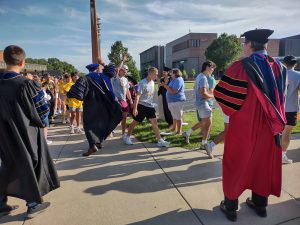
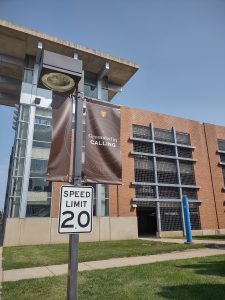 The longer I’m at Valpo, the more I’ve come to appreciate the rituals that bookend our academic year. (Twenty year-old me would not have predicted this.) I enjoy donning those odd, medieval robes, hood, and tam to line up and process down the magnificently long aisle of the Chapel in August, organ music swelling the usually thick, humid air as we welcome new students and the return of the academic calendar’s cycle. This year the cool weather granted us all a reprieve at Convocation–merciful when you’re attired in a polyester and velvet concoction.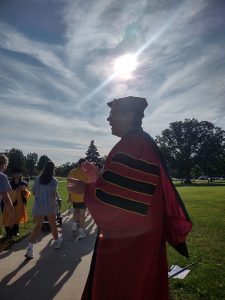
 Over the course of this summer and my internship at Erie House, one thing has became ever more clear to me each time I wake up and head to work: any number of individually insignificant factors can decide whether or not it’ll feel like a good day. For example, it could be cloudy but not raining, my bus is on time, and I have an extra minute to grab coffee before I clock in. That’s already a good day. Just as much, if it’s raining without an umbrella, both of my bus rides get delayed, and I have to show up twenty minutes late, that’s kind of a rough start.
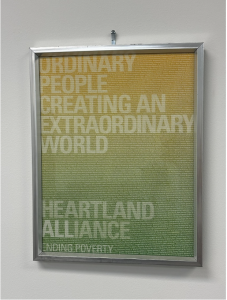 Today is my last day of my CAPS summer fellowship at Heartland Alliance. I look around the office. It’s quiet, a normal Friday morning as people mostly elect to work remotely before the weekend. Regardless, while everyone goes about their day, I sit here reflecting on some of the things I have learned this summer about both the work I have gotten to be a part of in refugee resettlement and as part of a non-profit at large in Chicago, IL.
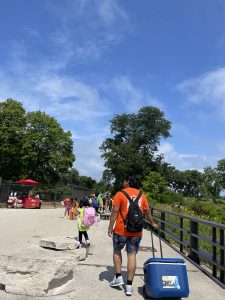 ‘I don’t know.’: the response that never feels good enough. Whether it is an answer to what you want, why you started, or what you plan for the future, few leave a conversation satisfied when you say ‘I don’t know’. But I, personally, don’t know a lot of things. I am a very indecisive person; I like to do a lot of things, and I don’t mind doing a lot of things, so, while some people might call me a people pleaser, I would say I’m just really adaptable. I want what others want because I would be content with either.
 A lot of people think that I am a shy person. But really, I am just an anxious person, and that results in me thinking and rethinking through any possible implications and consequences of any actions or words before doing or saying them. And when I do not pre-think through them, I will post-think through them afterwards. Or both, which can really slow an interaction. Shockingly enough, that kind of hesitation comes across as shy.
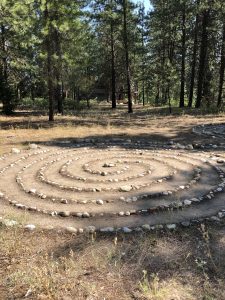 Just like at Valpo, the Grünewald Guild has a walking labyrinth outside, just beyond their central building and right next to the river. Anyone can use it at any point of the day, or night even. I actually heard from someone that they went out to walk it at night and stargaze. We use it during our final Vespers service of each program week too; to meditate on all the things we’ve learned from the week, to center ourselves and find a few minutes of peace and quiet inside our busy bodies.
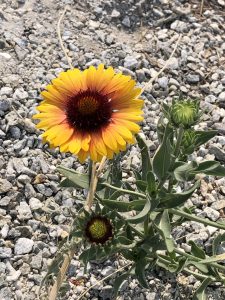 As I’m finishing out my internship here at the Guild with only one week left, I’m looking back on the memories I’ve made with the people and the land around me. Some experiences have opened new doors for me that I’d like to keep open as I come back to Valpo. Others have shown me interesting perspectives and walks of life that add to my understanding of the world and how I engage with it. I think I’ll be visiting our labyrinth at Valpo a lot more often next year.
 As of late July, I have served as a Communications Intern at Grünewald Guild in Leavenworth, WA for two months as part of my placement as a member of the CAPS Fellows Program. Through working in this position, I have exponentially grown to further refine my vision for my vocation as I approach the final year of my academic career at Valparaiso University. The mission of the guild is highlighted through the three core values of art, faith, and community and, since I am a Music and English major, I initially thought I would gravitate my attention mostly towards the value of art during my time here. Surprisingly, that was not that case and I started to primarily focus upon the aspect of community involvement and how it uniquely manifests itself at this non-profit organization. By nature, I have more of an introverted demeanor and it often takes me a bit of time to feel comfortable with expressing myself in a new environment. Interestingly enough, I did not feel as timid as I typically do during a transitional period of my life, and I think that lack of apprehension I felt is due to the Guild deliberately being a welcoming and community-oriented environment by its very design.
 Reconnecting with my high school viola teacher after three years brought up her valid question of, “Any updates with what you want to do with your life?” When I replied, “Well, I want to apply for programs to study or teach in another country for a year… Then possibly grad school for something ‘international’…” we both had to pause and laugh; nothing had changed in the three years since we’d last talked. I still didn’t have a set plan.
 As I near the end of my time at Jacob’s Ladder, I am once again given the chance to reflect on the different experiences and opportunities I have been given this summer. Among all the different opportunities that I have had at my placement, the ones that stick out the most to me are those where I could attend other meetings/events in the community. All of the events that I attended gave me the chance to meet new people, have meaningful discussions with others, and learn new information. These events helped me get out of my comfort zone and learn new information that I will carry with me far beyond my time at Jacob’s Ladder.
  At the beginning of June, I moved to a town I had never visited, to live in a house I had never seen, and to work with people I had only spoken to over Zoom. My family dropped me off, and once I had all of my things arranged, I sat on the bed and had a strange but very familiar feeling wash over me: What do I do now? I had the whole night ahead of me, but everyone I know and everything I do was scattered everywhere but here. The empty span of time ahead of me felt dizzying. So, I just sat there in the what-now feeling, thinking. I began to think about why this feeling was so familiar to me, and I thought of all of the other transitions I have had like this throughout my whole life: from the five times I moved as a kid, to the move into college, to my trip studying abroad, I began to realize that this is all old hat to me. I have done this before, and sure enough, I have done this again.
 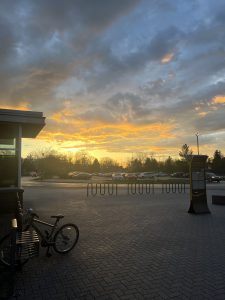 As my internship draws to a close, I’m faced with the same question that I begin the internship with. Why am I working with an environmental non-profit, what difference could I ever make?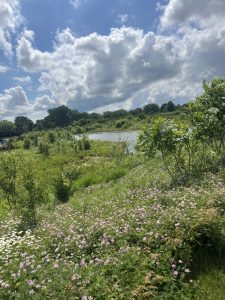
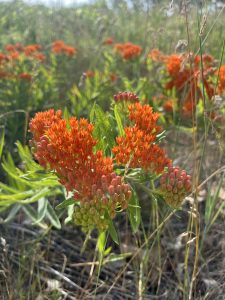 My opinions do matter, and it is possible to voice them loudly. Like a small rock making waves in a pond, a grass growing in the middle of a cracked sidewalk, a bee pollinating the vegetables in a neighborhood garden. My voice is not as small as I have been made to believe.
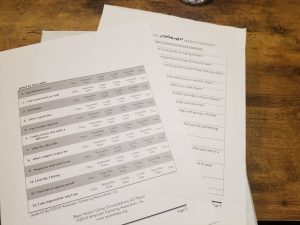 As I sit down to write this blog post, one realization crosses my mind. It is the realization that time keeps marching forward, and that is especially true when it comes to summer and my placement. As of the first week of July, I have officially hit the halfway mark of my duties serving Opportunity Enterprises and Camp Lakeside. The phrases “Time flies when you’re having fun” and “You never truly appreciate what you have until it’s gone” perfectly define and encompass what this experience has been. As I look back at what I have accomplished, a lot of it hasn’t felt as actual work. This is not only true for myself, but also for the campers and staff that I interact with on a daily basis. While much of my job is done behind the scenes, I also have many opportunities throughout the week to interact with campers in a way that I still fulfill my duties as a researcher for the camp and OE as a whole.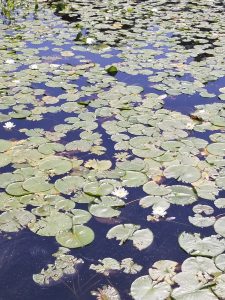
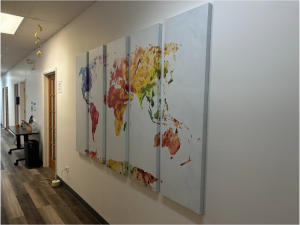 We often hear the phrase “don’t make excuses, make improvements”. For many, this may be a difficult thing to be told – this kind of statement misses and overlooks the individual nuances and circumstances of the situation we find ourselves in. But despite these challenges, we now find ourselves forced to continue on with no acknowledgement of them.
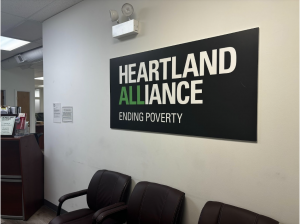 When I take a step back now and consider Heartland’s broader role in its community, it falls in some sense along the lines of this exact idea, providing solutions in all kinds of forms in housing, employment assistance, vocational English language training and even trauma assistance. The team here can only think in these terms (solutions, that is); when people’s livelihoods depend on you, you have no choice.
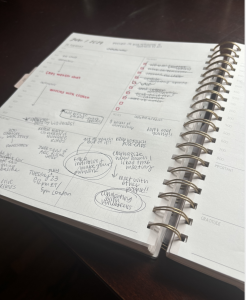 Now that I have over a month of my CAPS fellowship under my belt, it is easy to slip into a routine and let the day-to-day pass by quickly, and without much thought. May and June were a blur of emails back and forth, numerous to-do lists scribbled on Post-it notes, Zoom call meetings, and countless hours of staring at my computer screen. Don’t get me wrong, I am enjoying the work I’m doing and staying busy throughout the long summer days. I enjoy my lists and checking off projects as I complete them. But lately, a little voice in my head has reminded me of the importance of recognizing the small moments of purpose and slowing down before the summer comes to a close.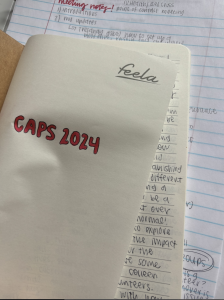
 Curiosity killed the cat is a saying that I have heard throughout my child and young adult life. While it may be true in some situations, the age old saying takes away from what I believe to be one of humanities’ main functions, and that is to explore the unexplored.