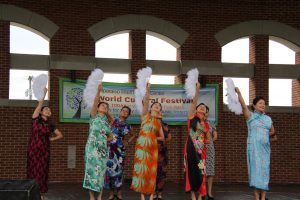
“Jasmine Dancers”: This image from last year’s World Cultural Festival features the Jasmine Dancers traditional Chinese dance group and hints at the wonderful performances this year’s festival has in store.
As a child, I loved attending a certain small festival in a downtown Valparaiso parking lot that sold trinkets from around the world. Maybe there were a couple performers singing melodies from other countries, or a food tent or two. What I didn’t know was that, years later, I would be working to put on that same festival, now celebrating its 15th anniversary and expecting to host 2,500 – 3,000 attendees in a unified celebration of international cultures. With the CAPS Fellows Program, I am interning with the Valparaiso International Center (VIC) in preparation for its annual World Cultural Festival, where I have already learned so much about event planning and the importance of relationships in community work.
I believe the most eye-opening technical aspect of my internship so far has been realizing the sheer mountain of details that goes into planning an event. Focusing on just one area of festival preparation, I’ve come to see that, no matter how amazing the day-of setup is, nothing matters without marketing. After all, if people don’t know about the event, they won’t come. VIC founder Duane Davison explained to me that we need to meet people in every place that they exist in the community.
So I’ve worked with a professional graphic designer to put an ad in a magazine, and we will soon release our festival’s poster design to be posted in cafés, stores, libraries, and even VU’s campus. I am also putting together a social media plan, and the VIC is including billboard ads for the first time in their marketing. By far, my favorite way we plan to get the public involved is having our first-ever float in Valparaiso’s Popcorn Festival Parade. Helping design one of the larger-than-life popcorn floats I’ve loved seeing all my childhood is truly a full-circle moment.
Working with the VIC has also shown me the importance of understanding relationships in the community. Nothing happens in a vacuum, and putting on this event has required participation from everyone from the Chamber of Commerce to the local library to Menards. I’ve met with individuals of all sorts of backgrounds and personalities, and I’ve been surprised by how much I’ve enjoyed this in-person work. I believe this internship has nudged me in the direction of looking for a career that includes lots of social interaction. I’ve also learned to look for the humanity and beauty in the “non-efficient” parts of workday interactions, whether they be meandering topics of conversation during a meeting or attending non-work events with fellow VIC members.
I remember in particular one evening when I drove out to our warehouse with others from the VIC team to take inventory of and clean our festival banners. However, we ended up spending an hour weeding an adjacent garden and talking about family, travel, and all sorts of topics. Looking back, I deeply valued this evening in the sunset garden as an authentic human blip in an otherwise work-driven world. Taking time for conversation is healing for the soul, and I hope to take this value of relationship-building with me into any future profession.
My elementary school self would have never guessed that, one day, I would be helping put on the World Cultural Festival I loved going to every year. Now, I find it hard to believe how fast the summer is flying by, and how every day uncovers a new aspect of this community I thought I had all figured out.
Come join the VIC for our World Cultural Festival on Sunday, September 15, 2024, from 12pm-5pm in Valparaiso’s Central Park Plaza!
- Lucia Otten, Valparaiso International Center
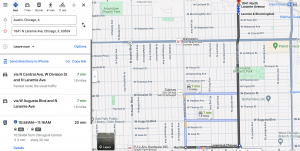 The easiest way to get to 1841 North Laramie Ave from Austin, Chicago by 10 AM every weekday without a car is to take the Green Line at Austin via Ashland/63rd, get off at Laramie & Lake, then take bus 57 towards Grand/Latrobe and get off at Laramie & Bloomingdale. In theory, this journey should only take about 33 minutes: a 5-minute walk to the station, a 12-minute train ride to Laramie & Lake, a 14-minute bus ride to Laramie & Bloomingdale, and a 2-minute walk north towards the building, meaning I could leave my house at 9:20 AM.
 For my second blog in two weeks, I was really struggling to find an experience that I did not touch on the week before this. As I was reflecting on my summer, already at the halfway point of this experience with Jacob’s Ladder and the CAPS Fellowship, I was thinking about what is a lesson I have learned.

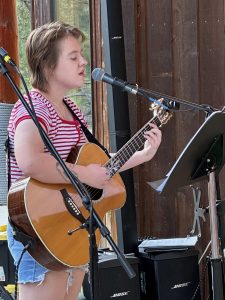
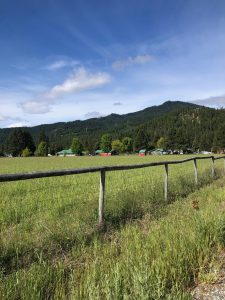
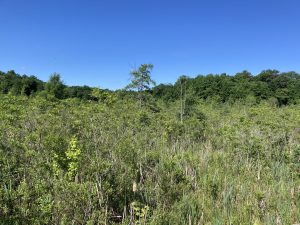
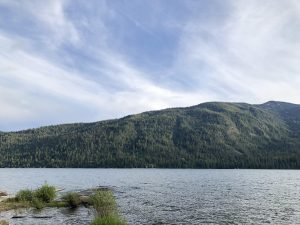
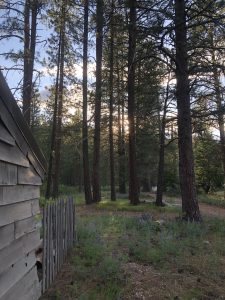
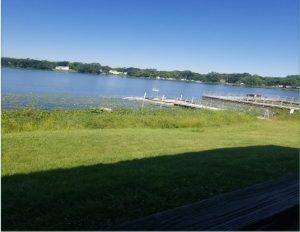 While the camp season has only just begun, I have had many different opportunities to fulfill my duties of collecting the necessary data for the camp. One of the biggest skills that I have used in the short time that I have been here is the art of creative productivity. In my position of direct observational research, that often means spending a lot of my day, directly or indirectly, interacting with campers. This has meant that, on multiple occasions throughout my week, I am often jumping in on games of “duck, duck, goose”, hanging out at the archery range, or even taking an afternoon boat ride around the lake.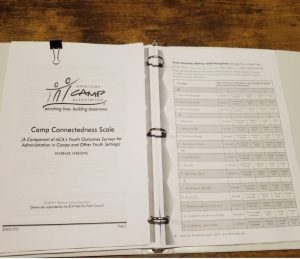
 hoved in a drawer, a hair tie that had been long abandoned, maybe a water bottle that had been forgotten during a quick departure. It is apparent to anyone who works in the Barker House that I don’t usually sit at my desk, and that’s something that I’m quite proud of. Let me explain.
 When I was a Valpo student, vocation was often discussed in my circles as being the place where one’s “deep gladness and the world’s deep hunger meet.” This is a classic statement from
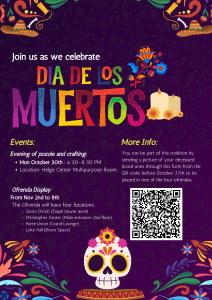
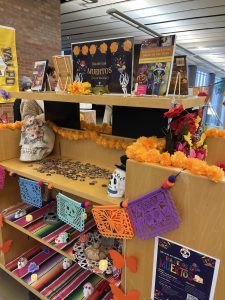 Students and faculty will gather at several locations across campus this week to celebrate Día de los Muertos, a Hispanic cultural tradition honoring loved ones who have passed away. The kick-off event will be an evening of crafting and pozole, a traditional Mexican soup, from 6-8 p.m. on Oct. 30. The Valpo community also had the opportunity to submit photos of their loved ones to be displayed on commemorative ofrendas, Spanish for offerings, on the second floor of the Christopher Center Library, Harre Union, Loke Hall and the Gloria Christi Chapel Nov. 2-8.