Valpo Voyager

Student Stories from Around the World

Page 7 of 124

Solo in Seoul

Author: Brandon Polinski

Location: Seoul, South Korea

Pronouns: He/His/Him

I recently went to the capital of South Korea for three days. I went by myself, since most people who had interest had either gone during fall break when I was in Tokyo or were starting to run out of money. I’m honestly glad, because I have been too dependent on others when it comes to traveling, so this was a good opportunity for me. I learned a lot about another country I have been interested in, and a future trip of a longer duration is certainly on the table.

Seoul is about a two-hour flight from Kansai International Airport. Currently, partially due to strained relations between Korea and Japan, flights are also very cheap. I was able to get a round trip for approximately 100 USD. This was almost half as much as the cost of flying to Tokyo.

What did I think? I have a lot of thoughts. I had no experience in Korean culture or language, so this was probably the steepest learning curve I’ve ever had to adjust to in the shortest amount of time. Thankfully, in terms of infrastructure South Korean public transportation is functionally the same as it is in Japan. There are a few differences to keep in mind when it comes to navigating the stations, but if you can get around Japan without getting lost, the same will go for South Korea.

Everything else was much more difficult and uncomfortable. I want to avoid generalizing, since I was just in a small part of a country for a very short amount of time, but I want to talk about what I observed.

To begin, this really drove home what draws me to Japan. Not the food, or the cool shiny things, or even the pop culture, but the people. At least to me, there is a level of kindness and hospitality among the Japanese people that I have not experienced anywhere else, not America, and certainly not South Korea.

That’s not to say there are not many, many kind people in all countries. When I arrived in South Korea, without me asking, a man helped direct me to the correct train line and then gave me free food and his contact card. There are stand-out individuals everywhere. The difference is cultural. There is a warmness that permeates Japanese culture. I can count my negative experiences with Japanese people on one hand.

It is true that much of that perceived warmness is often part of an act or service (I do love Japanese service workers though :)) and does not always reflect the true feelings of the Japanese. However, being in Japan as a tourist or visitor, (Especially a western one) feels more comfortable, and arguably that is what matters for a temporary stay. Seoul is a beautiful city, in some ways I liked it more than Tokyo. Cutting edge technology, massive landmarks, but also wisely designed and spacious streets. Aside from the train stations during rush hour, I never felt claustrophobic even though Seoul has an even higher population density than Tokyo. But I felt a certain level of coldness among the residents. Not an aggressive rudeness like you find might in America or elsewhere, but it was there, and it was uncomfortable. Incidentally, Seoul is the largest city in South Korea and one of the largest in the world (It is bigger than New York!), but I noticed far less foreigners there than many smaller cities I have been to in Japan. There was a real feeling of isolation, like nothing I had ever felt before.

Despite some of my discomforts, I enjoyed Seoul. South Korea is without a doubt one of the best foreign destinations for solo travelers, thanks to its public transportation and a high level of safety that is comparable to Japan. For a still very inexperienced traveler, it was a very safe bet. I am glad I did this, things in my life that used to seem difficult or intimidating certainly seem much less so now. When I return, I will try to have learned some basic phrases, see if I can reach a higher level of understanding of the culture, and maybe break down more barriers between myself and the locals.

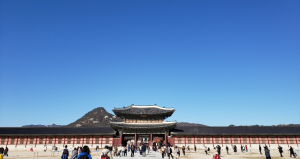
The entrance to Gyeongbokgung Palace. The most visually striking place I saw in Seoul.

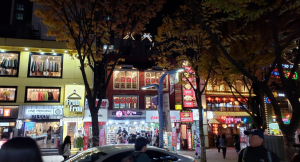
Part of Hongdae district. Known as the “young people’s” district. Full of shops and street performers.

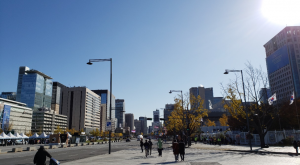
I found the streets and sidewalks to be more spacious than Japanese cities. Not the case everywhere, but I was pleasantly surprised.

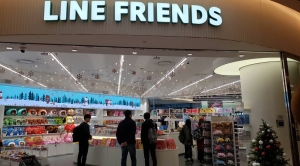
A Line Friends store in Lotte World Mall.

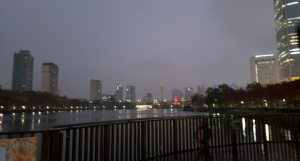
The night views did not disappoint me.

Exploring Europe

Author: Bianca Gamez

Location: Italy, Greece, &  Spain

Pronouns: She/Her/Hers

As my classes started to come to an end, the Boston University Program gave the students a week of vacation before we had to start our internships. A couple friends and I decided that we should use this week to explore the rest of Europe and be “tourists”. We planned out our week to leave immediately after our finals and make our way to Rome, Italy for a day, Sorrento, Italy for three days, then Athens, Greece for a day, and finish up in Barcelona, Spain for the rest of break. At first, we did not realize that we were being very ambitious about our trip until we would talk to others about our plans to explore Europe, and they would just stare at us with shock in their eyes.

Regardless, we continued with our plans and took a flight from Paris to Italy, and it was one of the best decisions I have ever made. Italy has so much to offer and so much to eat! My friends and I ate homemade pasta, pizza, and cannoli whenever we would go out to eat. We also ended up exploring the Colosseum, Pompeii, the Trevi fountain, and swam in the Mediterranean Sea.

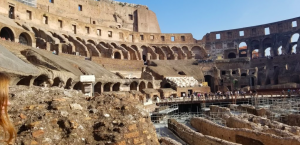
(This was inside the Colosseum in Rome, Italy. We only had to pay 2 euros to get in because we were considered EU students)

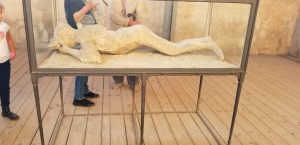
(This was one of the “mummies” in Pompeii. Pompeii only has this one and three more inside of the city)

When we made our way to Athens, we mainly focused on seeing the Parthenon, the Acropolis of Athens, and the Temple of Zeus. Afterwards, we went to the street markets to look around and we even had the opportunity to experience a Garra Rufa fish session, which is when fish eat the dead skin off your feet.

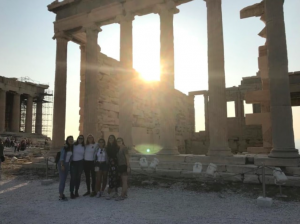
(This was at the Parthenon and from left to right it was Serenity, Mykie, Allie, me, Ciarra, and Emily. All of us attend the same study abroad program.)

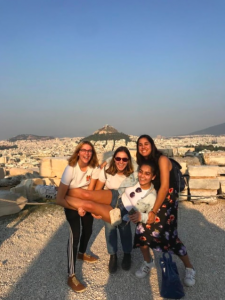
(This was also at the Parthenon, but in the background is the town of Athens and one the mountains.)

In Barcelona, which was our final destination, my friends and I decided to take it easy since we were so exhausted from all the traveling, walking, and exploring so we didn’t do too much adventuring. We did, however, visit some of the well-known cathedrals and attended a paella (a Spanish dish) cooking class.

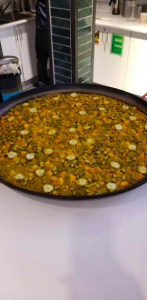
(We took a Paella cooking class in Barcelona, and this was the final product.)

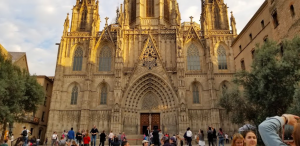
(My friends and I passed by the Cathedral of Barcelona.)

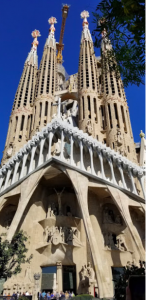
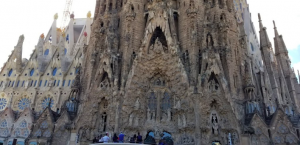
(We also ended up passing by La Sagrada Familia. The cathedral is still going under renovations, and we were told by locals that it is expected to be done by 2026! The top picture is from the front of the Cathedral and the bottom one is from the back.)

Overall, exploring Europe has given me the opportunity to be exposed to different languages that challenge me to learn new words and be able to appreciate the culture and traditions of other countries. This experience opened my eyes to how the culture is different in the U.S. and Europe and how one has to fully immerse themselves to that culture to truly obtain the essence of that country and culture. On the other hand, I also learned that culture shock is true and can happen at any moment. For instance, I experienced culture shock when my friends and I would walk around to find a place to eat and every place would have someone outside of the restaurant that would try to persuade you to eat there by offering free dessert, free wine, or just explain how wonderful their place is compared to the others. I personally did not like this and found it to be overwhelming and annoying after a while, but I slowly grew accustom to it, and I am now capable to continue walking and just say no thank you.

“Sláinte” to Dublin

Author: Elisabeth Walters

Location: Dublin, Ireland

Pronouns: She/Her/Hers

Normally, back at Valparaiso University, we are only granted two days plus the weekend for fall break. However, when studying abroad at Reutlingen University, the students are granted a full week. Thus, majority of the students were able to utilize ten days to either travel to other places or stay within Reutlingen. My roommate and I decided to travel around Ireland and the United Kingdom to once again experience different cultures. During our first two days of break we decided to spend that time in Dublin, Ireland.

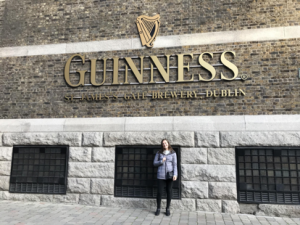
We left on a train to Frankfurt International Airport on Wednesday night in order to make our flight at 6 am on Thursday. We decided that sleeping in the airport was more economical than getting a hostel for only a few short hours. Luckily, it worked out for the best and we made our flight and arrived in Dublin at 8 am. When we arrived, we immediately visited the Guinness Storehouse. At the Guinness Storehouse we got to learn about a major aspect of Irish culture, Guinness Beer. We got to learn about the different ingredients as well as how they are grown and how the company mixes the ingredients to get the well-known taste. We also learned about the company’s marketing tactics as well as information regarding the founders of the company.

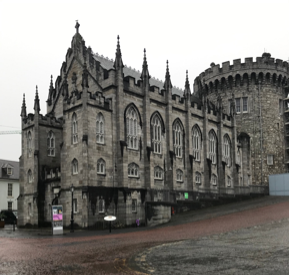
The day after visiting the Guinness Storehouse, we did a free walking tour of Dublin through our hostel. Through our tour guide, we learned about how Dublin got its name through the Gaelic term dubh linn, which means “black pool”. The city received this name because at Dublin Castle the Poddle Stream met up with the River Liffey and created a deep pool. Also, we learned that Ireland has its own language, known as Irish Gaelic, and one of the words we learned was “sláinte”, which means “cheers”. In addition, we learned aspects of the city through our guide that we would have never learned by just walking to the sites and taking pictures. We learned information that helped enrich our ideas of the beautiful city and the country’s culture.

Dublin Castle

After our walking tour, my roommate and I hung out in our hostel’s lobby. During this time, we ended up meeting two other American students studying abroad, one in Paris and one in Barcelona. We ended up talking with the two other students for over two hours and learned more about their own experiences abroad and about their exchange programs. Thus, through this experience we were able to make new friends with other travelers and learn more about the cultures they were studying in.

Overall, by visiting Dublin, I was able to not only expand my cultural knowledge, but meet new people from where I call home. Also, I am able to come back from Dublin saying that I did more than just visit the sites, but I actually learned about what makes these sites so special to this fascinating city.

Egypt

Author: Elisabeth Walters

Location: Cairo, Egypt

Pronouns: She/Her/Hers

When studying abroad, students often take the opportunity to travel around their country of study or surrounding countries. For students studying in Europe they usually stay within Europe; however, my roommate and me decided to test the waters and go to Egypt. Originally the idea started off as a joke, but as other students in our program kept doubting our survival in Egypt, it turned into a reality. When planning our trip, we looked into the cultural behaviors and cultural mindsets of the area that we would visit. We learned that wearing loose fitting pants and having our shoulders covered was more appropriate during our stay. We also learned through our research that we needed a travel visa for the time in which we were staying. Luckily, the travel visa was available for us to purchase and receive at the airport in Cairo when we arrived early Thursday morning.

After getting our travel visas and exiting customs at two in the morning, my roommate and I were bombarded with people asking us whether we needed a taxi. Although we were offered several offers, we decided to stick with ordering an Uber on the app because it felt the safest. However, while ordering our Uber another “Uber driver” approached us and offered a higher priced ride; after we declined, he continued to follow us throughout the airport to our actual Uber pick up point. Thus, our first impression of the Egyptians was that they were persistent.

When we arrived at our hostel on Tahrir Square at four in the morning, we decided to sleep in and then explore the city on our own. After waking up, we ventured out and walked on a bridge above the Nile River and around parts of Cairo and Giza. During our walk, we got to experience the crazy streets of Egypt and quickly learned that in order to get to the other side of the street, you just need to walk without fear in the middle of traffic.

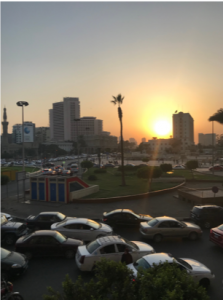
The view of Tahrir Square from our hostel room.

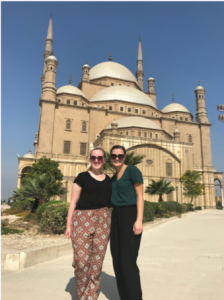
On the second and third day of our stay, we had a tour guide to take us to different attractions in the area. On Friday, we visited the Cairo Citadel and the Mosque of Muhammed Ali, here we were required to remove our shoes and make sure our shoulders were completely covered because of religious and cultural reasons.

My roommate and I at the Cairo Citadel

The Mosque was also the place where I learned that more Egyptians were taking pictures of my roommate and I than the actual attraction. For example, while I was taking a picture of the inside of the Mosque, I was asked to take pictures with young children by their mothers. At the time I did not understand the reason why this often occurred, but I learned by the end our trip. After the Mosque, we visited the Egyptian Museum, went on a felucca ride on the Nile River, and visited the Khan el-Khalili. During our time in the museum, once again, people were taking more pictures of me than the artifacts. Then in the Khan el-Khalili, which is a huge market area, we experienced more persistent Egyptians trying to get us to make purchases. Also, we utilized our bargaining skills in the market and other shops in the streets of Egypt because in a majority of shops there are no fixed prices, a notion which was different from both the United States and Germany.

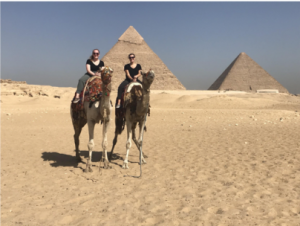
By our third day in Egypt we were accustomed to the persistence of the people. Thus, when we visited the Pyramids of Giza, we were able to ignore the people and truly enjoy our time. At the Pyramids of Giza, my roommate and I witnessed the towering and ancient pyramids by foot and by the backs of camels. While having our hour-long camel ride we were able to witness beautiful views of the pyramids and surrounding areas.

My roommate and I on a camel ride around the Pyramids of Giza.

Therefore, I suggest, if one is ever in Egypt, to ride camels because it is both a unique and weird experience. After the pyramids, we learned about the different types of oils and perfumes sold and produced in Egypt, as well as how it affects the country’s economy. Then, we learned how ancient Egyptians created and utilized papyrus paper. After our tiring day, we returned to the hostel and left the next day to return to our university in Germany.

Although we only spent a few days in Egypt, I learned about a culture that was both different from the one I’m from and the one I’m studying in. Also, I learned that when visitng another country with a different culture, one needs to remain patient and open-minded or else that culture could be misundertsood. When remaining patient and open-minded, the true version of that culture will unfold before your eyes and only then can one accurately say whether they understand or not.

The Bongic Community and Naso People

Author: Mia Casas

Location: Bocas del Toro, Panama

Pronouns: She/Her/Hers

The next destination of our study tour, following our stop in Panama City was an indigenous community near Bocas del Toro, Panama. Although we slept most of the day when we initially arrived, this trip was by far one of my favorite adventures. We arrived at the Bongic indigenous community early in the morning, after an exhausting 12-hour bus ride from Panama City. Even after we arrived at the bus stop in Bocas del Toro, we still had to drive an additional thirty minutes (maybe even more) to this community. I expected to be in a remote location, very far and distinct from the city life.

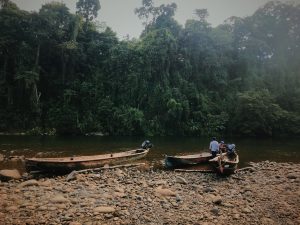
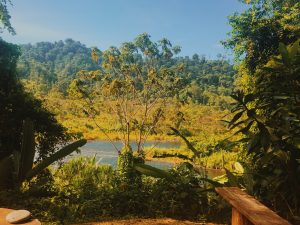
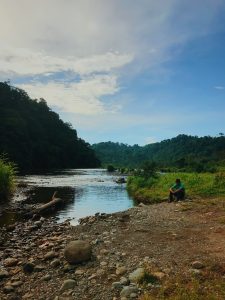
Students crossed the Teribe River to the Parque Internacional La Amistad.

My expectations were partially true. The Bongic community was once very secluded from the rest of the country. Up until recently, there was no road from Bocas del Toro to the indigenous people. Before the only way to access the community was by boat. Given this limited accessibility, the community is strongly characterized as self-reliant. For food, the community raises its own plants and modest livestock. It is very normal to see roosters and hens roaming throughout their neighborhood. They also constructed their own homes and other living spaces. Although these buildings were by no means luxurious, they were beautiful. The gardens, the landscape, and the livestock all created a harmonious living space. 

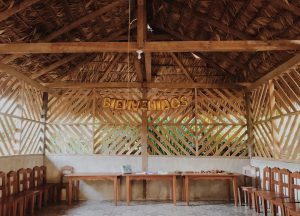
Bienvenidos. A warm welcome to the Bongic Community.

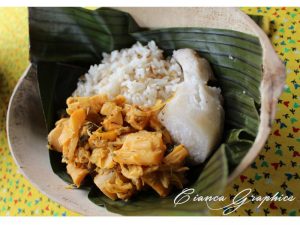
Our hosts prepared a total of four meals for us, which featured typical foods such as yuca or heart of palm. There were certainly some other things that I was not familiar with. Curiously, all of our meals were served on a plate or bowl, but also with a piece of leaf in between the plate and our food. The meals they prepared us demonstrated the generosity of the people. I could see how limited their supply of meat was, for example, yet they still chose to serve us meat. 

You can observe a typical meal prepared by the host, with small portions of hearty food served atop a piece of banana leaf.

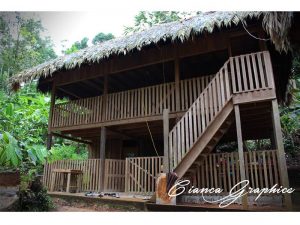
Following our dinner, the children prepared a number of songs and dances for us. Then, the women told us stories about the community. I was particularly impressed with their story regarding how they founded a local indigenous women’s organization in 2010 called Organización de Mujeres Unidas Bonyic, which consists of 13 women and one male. Their organization is primarily responsible for the educational tourism that the Naso people have begun. This group of women petitioned funds from the government, affording them access to building materials to begin their project. Ultimately they constructed the Hostal Posada Media Luna, where we lodged.

The Hostal Posada Media Luna can house up to 12 visitors at a time.

This group of women shared an impressive story of empowerment and triumph. Although they lacked formal education, they composed a compelling grant superior to other applicants. In this grant, they needed to articulate their business plan to develop their community through mediums of tourism, ethnobotany, and other indigenous traditions and knowledge. Upon receiving the grant, their next step was to design and architect dormitories and another area to host events. Finally, they realized their plan and worked laboriously to construct these buildings by hand, with very little help from their spouses. This feat highlights their abilities to overcome economic and educational barriers, in addition to personal struggles. They shared that on multiple occasions their homes and livestock had been completely wiped away due to heavy rains and flooding.

Students listened to the women leaders expound on the establishment of their organization Organización de Mujeres Unidas Bonyic.

Due to the hardships the community has faced, the women feel pressed to secure forms of preserving and edifying the livelihood of their community, as they have done with their initial project with Hostal Posada Media Luna. Their organization continues other projects that enriches the lives of its community members on group and individual levels. One organizer had the opportunity to travel to Cuba to attend a business-related workshop. The organization sponsors such events because they aspire to provide better services to their guest, with the aim of benefitting their community, as well. I would have never guessed the accomplishments of these humble women, but now I admire them more than they know. They are full of knowledge and wisdom, and I wish I could have spent more time listening to all of their experiences.

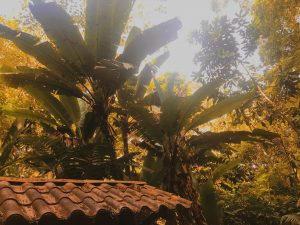
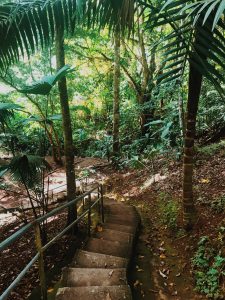
Landscapes of Parque Internacional La Amistad

Trips You Will Tell Your Kids About Someday: New Zealand

Author: Sarah Tubbs

Location: Dunedin & Christchurch, New Zealand
Pronouns: She/Her/Hers

October 14th, 2019… 9:10PM…. Truly a bittersweet day. My final day of being my current age. Being on the other side of the world, away from close friends and family, turning 21 in less than 5 hours, and just getting back to Newcastle from one of the most monumental weeks of my life. Taking it back to the night of October 5th, four of my girlfriends and I were flying out to New Zealand to start a week long road trip throughout the South Island. We had flown out of the Sydney International Airport and landed in Christchurch, New Zealand not too long after. Finding cheap flights in Australia can be very easy, but the times of these cheaper flights can sometimes be very inconvenient. Due to buying the cheapest flights we could find, we ended up arriving in New Zealand at 2:30am. We couldn’t pick up the rental campervan until 8am, so we all slept on the international arrivals terminal floor for about 5 hours. This was such a wild experience because WE WERE FINALLY THERE in New Zealand, all of us so ready to begin our adventure, but we were completely exhausted and had to wait to pick up the campervan that are international friend Krista had rented. But as soon as 7:50am rolled around, we were up and at it, ready to get on the road.
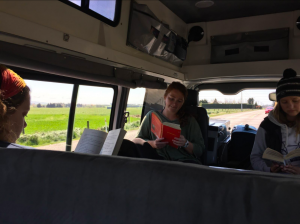
Krista, Linneya, and Sammi reading in the back of the campervan on our way to Dunedin!

Our first stop was Dunedin, located four hours south of Christchurch. We decided to go here because Holly and Linneya both had friends who were studying abroad at the University of Otago. The four hour drive ended up turning into a six hour one because we kept on stopping at different beaches and lookout points that caught our eyes. These first hours spent exploring and finally being in New Zealand was only the start of the beautiful landscapes and sceneries we were about to see in the upcoming week.
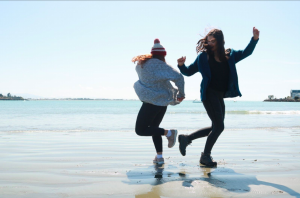
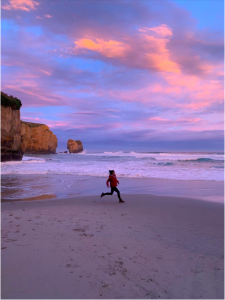
Krista and I dancing on a beach on our way to Dunedin

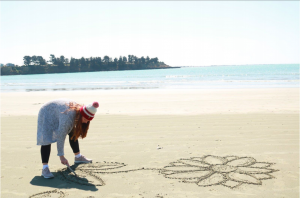
Krista drawing sand art on a beach

The first night we arrived in Dunedin, Sammi, Linneya, and Holly all went and spent the first night and day with their friends who were studying abroad. Krista and I slept in the campervan alone and decided to get up early, get coffee, and go find a hike to do in the area! We woke up at 6am and headed out to whatever coffee shop we found along our way. After sitting in a coffee shop for a little while and reading (such a beautiful moment, everyone should READ MORE!), we walked around the shops a bit more. While we were in one, we sparked a conversation with the owner who told us her favorite hike in the area was the one called Organ Pipes. She mentioned that not many people knew about this hike, but that is was one of the best ones in the area. After hearing this, we knew that we had to go to this hike. We were stoked to now know about a local hike we could do for the day! The entire time after we had talked with this woman, we kept thinking about how it was such a beautiful experience to be able to have such kind conversations with the random people we met along our way. We searched for the hike in Google Maps, and we hit the road. The hiking path was about 25 minutes outside of the town and then the hike was a total of four hours round trip. We found parking and started hiking along the unknowingly steep path that we were about to experience. And woah!!… we understood why this hike took four hours long after only 5 minutes on the path. This thing was straight uphill and had SO many stairs… but after 2 hours of slowly making our way up, our knees shaking from the climb, we got to see the view that was worth the long haul upward.

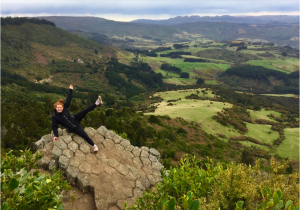
Krista and I at the top of the Organ Pipes Trail in Dunedin, NZ

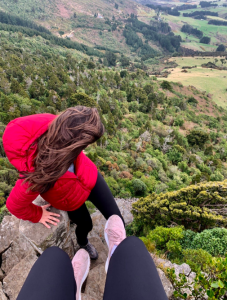
Krista at the top of the Organ Pipes Trail in Dunedin, NZ

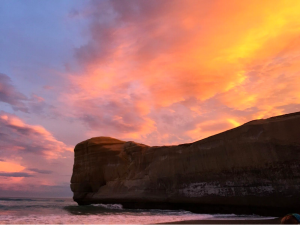
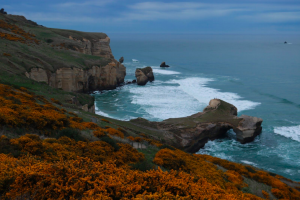
The air and the views that we got to experience at the top of this mountain were unlike anything else. We were almost in the clouds and it was a hike I’ll never forget. We sat up there for almost an hour. Simply breathing in the air and finding such peace with the sounds of nature. This day was one of the highlights of the entire trip, from the morning including the hike to the Organ Pipes and the sunset hike to Tunnel Beach later in the night. After Krista and I spent the day at Organ Pipes, we met up with everyone else back in Dunedin and drove to Tunnel Beach to watch the sunset. The experience here was one I could never put into words, and truly something that I’ll keep in my memories forever. So I hope the following pictures help to somewhat capture what it was like that night on Tunnel Beach.

Running around at Tunnel Beach

Sunset Over the Rocks at Tunnel Beach

The View on the Way Down to Tunnel Beach

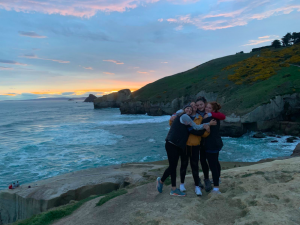
Lots of Hugs <3

These days were only the first two days of a six day long adventure we all had together. So much happened in the next four days, from the campervan breaking down, hiking in the pouring rain, to dancing with two little girls at a random petrol station, go-karting down a mountain, and so many more amazing memories that I will never forget. It would be such a long blog post if I told every moment of what happened throughout our week in New Zealand, but overall this was one of the most transformative and unforgettable weeks of my life. This trip encouraged me to push myself towards my dreams that I want for my future, and showed me that so many things are possible if you stay kind, attentive, and courageous no matter where you are in the world. Even though this trip wasn’t all great moments of crazy adventure (there was a lot of challenging stuff that happened), I found myself to be so grateful with the women that surrounded me and our ability to communicate with one another and figure things out as they happened. It made me realize that no matter where you are in the world, you can always find comfort and love in the community that is around you if you look for it.

So when you’re abroad, don’t forget to stay in the moment and LIVE your LIFE! A quote that has been following me around while in Australia has been one by Eckhart Tolle. He once said that, “Most humans are never fully present in the now, because unconsciously they believe that the next moment must be more important than this one. But then you miss your whole life which is never not NOW”.

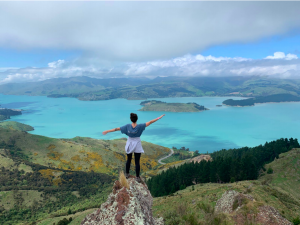
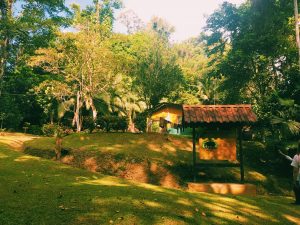
Last Hike in Christchurch, New Zealand
Taking Courses in Paris

Author: Bianca Gamez

Location: Paris, France

Pronouns: She/Her/Hers

As a Political Science and French double major, I always knew that I wanted to study abroad somewhere in France so I can be fully immersed with the culture and language. However, I never would have imagined actually having that dream of mine come true. As many students who have studied abroad know or who are currently applying to study abroad, the application process is tedious and the transition to a new country can also be a bit difficult. On the other hand, the experience received by being able to study in a different country is unforgettable. I decided to study abroad through the program provided by Boston University which includes half the semester of classes and the other half we get an internship in our concentration.
Currently, I have been taking classes that started on the 6th of September and will be ending on the 25 of October. The classes I decided to take were art history, the study of French cinema, theater, and songs, and a language course on French writing. I made the decision to take courses that would help me obtain a better knowledge on the French culture and not just on the language. My art history class has exposed me to not only the history of art but to the meaning of art in France especially in Paris. For instance, art in Paris is important in their culture and it’s a conversation started, as well, because as my professor said art is one of the first things French people were exposed to because it is everywhere. Throughout this course, we have visited the Museum of Orsay, Museum Marmottan, the Nation Art Museum of Centre Pompiduo, and Palais Tokyo. The course began from the classical art pieces to the more modern pieces of art and we talked about how each style of art was influenced.

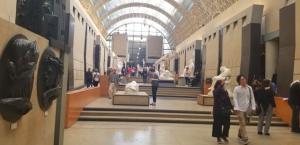
(This was at Musée D’Orsay)

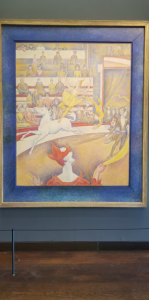
(This was one of my favorite pieces of art at Musée D’Orsay which is by Seurat called Cirque)

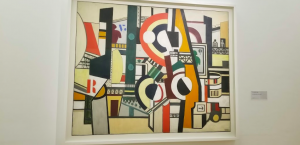
(This is a piece from Centre Pompiduo which is considered to be more modern)

My other course on cinema, theatre, and songs offered me the same opportunities with outings to go see French films in the movie theaters and see French plays at the theaters. This course has been teaching me about the law on French radio stations and about the culture around plays and movies. For example, I learned that French radio stations have a law where their music that they play has to be 60% French music and cannot play the songs numerous of times throughout the day. The reason they have this is to help make sure those hearing music on the radio are being expose to different types of music. In addition, this course was a bit more difficult than the others because when the class would go to the movies or the theater there were words that I could not understand and sometimes the dialect spoken would be challenge. Because of this, I always had to remind myself that it’s okay not to know everything that is being spoken because this is the reason why I am studying abroad, so I can speak more fluently the language and understand the culture and traditions here.

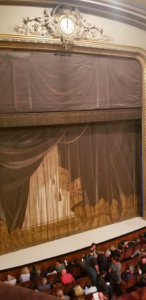
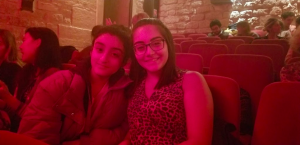
(This was when my class went to the theatre to watch the play Art by Yasmina Reza at the Theatre Antoine)

(My class also went to a smaller theatre to go see the play Et pendant ce temps Simone Veille)

So far, I have been very pleased with the decision to study abroad in Paris. Every day I am exposed to new challenges where I am forced to get out of my comfort zone. For instance, in the beginning of the program, I had no idea how the metro worked and how to get a metro pass so I was forced to ask multiple people for directions and assistance in a language where I did not feel that I could fully express myself. On the other hand, now the challenges for me are figuring out where I have not explored yet and making sure that I speak French almost the whole time with my friends so that I am prepared to speak it at my internship which is at a law firm. Overall, I look forward to learning new expressions and words from Parisians around me and at my internship.

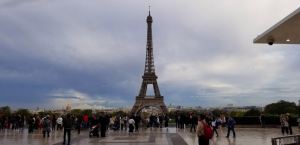
(The Eiffel Tower at the stop Trocadéro)

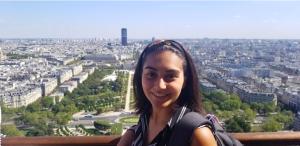
(Me on the first floor of the Eiffel Tower)

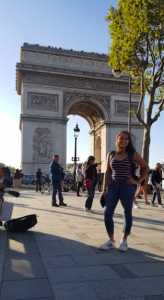
(Me at the L’arc de Triumph before a couple of friends and I had dinner on the Champs-Elyssées)

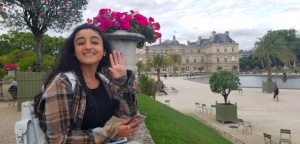
(This is when my friend, Lidia, and I decided to go visit Le jardin de Luxemburg (the Luxemburg Garden) in Paris)

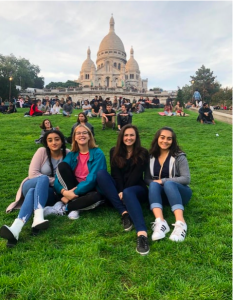
(My friends Lidia (far left), Allie, Emily, and me at Sacré-Coeur enjoying the nice day)

Fall Break Adventures

Author: Gwyneth Hoeksema

Location: Windhoek, Namibia

Pronouns: She/Her/Hers

This past week was our Fall Break, in which we did not have any classes. Therefore, I tried to busy myself with things to do in the community. The most interesting and enjoyable part of the week was when some of us students went on a hike at Daan Viljoen Nature Reserve and when we went to the Independence Avenue block party. I enjoyed both events immensely and both made me feel closer and more connected with the community in Windhoek.

At the nature reserve, we were joined by some of the staff, which made it all the more fun. Daan Viljoen is a private nature reserve in which people can go camping and hiking. We were fortunate enough to see some of the wildlife that the park holds, including giraffe and baboons, while we were driving into the park. However, on the hike itself, we only saw baboons in the distance. We chose to walk the nine-kilometer trail, which proved to be rather grueling but very invigorating! It was a mountainous and rocky terrain which, at times, made everyone out of breath. However, accomplishing the challenge made the struggle, and getting up at 6:30 in the morning, all worth it. The amazing views of the surrounding mountains and the city of Windhoek in the valley below also made the hike worth it. While it was amazing to see the city spread out below, I also noticed a haze of smog surrounding the urban area. Being in a mountain valley and having very little rain often contributes to excessive smog. As we have learned in our environment class, Windhoek is one of the first cities in the world to turn gray and black water back into drinking water. This water reclamation solution is a fantastic example of how the city is working towards being more sustainable. However, the presence of the smog emphasizes how the city has more work to do to lessen air pollution. A possible solution to this would be to build bike paths in every neighborhood of the city. I have noticed that many people walk on the sidewalks already, but adding bike paths would be a safer, faster, and more sustainable way to get to work. This idea was also emphasized during the block party, in which many children and adults took advantage of the closed road by biking all around it. Overall, I enjoyed my walk through Daan Viljoen, and I would definitely do it again, as long as there was cloud cover.

The block party on Independence Avenue on Saturday morning was also enjoyable. It was one of the first times in which I was truly comfortable being out and about in the city. I was more comfortable because the goal of the block party was to encourage a safe, neighborly space for children and families to enjoy. I thought that this was an interesting idea, and it sounded like community building has been difficult in the past, or people have not felt as safe as the city wants them to feel. I can see evidence of this in the lack of parks and open spaces for children to play in and around the city, which understandably limits the ability of families to go places. Events, like the block party, are also few and far between which decreases the ability of families to be present in the community. The block party was an example of how welcoming the city can be for families, holding the possibility of future developments that will be more family friendly. Some of the friendly and fun things to do included big bouncy castles, fun music and drummers, and many food and clothing vendors. There were also vendors passing out some free food, including some delicious smelling dumplings that I wish I had eaten. There were also adults and children riding bikes and scooters around and running up and down the closed off street. The many numbers of people biking up and down highlighted the fact that I have not seen any bike paths in the city. I realized how lucky I am to be able to bike up and down the sidewalks and nice flat bike paths of my hometown without fear of being hit by a car. The ability to exercise in a fun communal way is a blessing and a way to bring my family together, as we all like to go biking with each other. It seems as if the city has not spent very much on establishing safe spaces for families to use. One simple solution would be to establish bike paths that could also increase the city’s environmental sustainability by lessening the amount of cars on the road. As I mentioned before, when I went to Daan Viljoen, there was a slight haze of fog over the city. Bike paths are also a fantastic way to reduce toxic smog commonly found above big cities.

Although it was only one block of activities, it was very enjoyable, and I am glad I attended. Throughout my stay here, getting out in the community has been difficult because I have been nervous about safety. However, the hike through Daan Viljoen and especially the Independence Avenue block party made me feel much more comfortable with my surroundings. It was lovely to get out of the house and go see some children running around the city center. I have to repeat how I have not seen very many children around our house in Windhoek, or in the city center. It was a refreshing change of pace to see young families and brought the realization that the city does not have as many family friendly spaces as it should. If Windhoek were to build more parks, playgrounds, and open green spaces for kids to play it also might increase the safety of the city by making its residents feel more comfortable. I definitely think that the city should host another event like that soon.

The weekend was very enjoyable and full of lots of community-based activities. These activities increased my comfortability with my surroundings and made the city that I am in much more familiar. Before this past weekend, my opinion of the city has been that it is filled with twenty-year old’s and up. This is due to our house being right next to the Namibian University of Science and Technology, or NUST. I often see college students, but I almost never see families with their children. However, the high concentration of young people at the block party offered me a more realistic idea of the demographics of the city. It also made me understand that the reason I don’t see many young families is because there are not spaces that those demographics can enjoy, there are not many parks or recreation areas for children to safely play. I truly enjoyed the weekend, and hopefully the city hosts more events like this before I leave Namibia.

The Panamanian Color Spectrum

Author: Mia Casas

Location: Panama City, Panama

Pronouns: She/Her/Hers

On Saturday, September 14, our cohort embarked on a trip to Panama City. Not knowing much about Panama, I did not know what to expect from the country. At dinner, one of our guides, Jorge, asked me what I knew about Panama previously. I looked at him with embarrassment, and admitted that I did not know much besides (1) it is home to the Panama Canal, and (2) it was once occupied by the United States. So, he asked me what I thought about Panama, so far. Truthfully, I told him I was surprised to see so many Afro-Latinos in Panama. (Both of our guides that day were Afro-Latinos). Previously, I was under the impression that most Afro-Latinos come from Caribbean countries, like Cuba, Puerto Rico and the Dominican Republic.

Jorge understood my misconception and shared that he experienced this in the United States before. Once, he lived in the US for about 2 years. He said that many African Americans would look at him crazy when they heard him speak Spanish, and give him a look that said, “How do you know how to speak Spanish?” Meanwhile, fellow Latinos were also astonished and said things to him like, “Who taught you how to speak Spanish?” So, although many, even other Latinos, are surprised by Afro-Latinos, Panamanians seem completely accustomed to the mixture of color that exists within their country.

Jonathan Davis served as one of our tour guides for four days in Panama City. Here he is pictured at Biomuseo, a museum of biodiversity at Panama.

Although within the United States exists a multitude of different cultures and ethnicities, certain environments are not always representative of this diversity. I was surprised to see every color of Panamanians eating at the restaurant. Similar to the United States, Panama has also had a history of racism towards Afro-descendants. We had the opportunity to visit the Afro-Antillean Canal Workers Museum, a place that honors the contributions and hardships of African descendants in the country. As the name of the museum implies, many Afro-descendants, particularly from Jamaica and Barbados, traveled to Panama to work on the construction of the Panama Canal. However, Afro-descendants and other minority groups commonly faced racial discrimination that manifested itself in segregational practices and wage inequalities between black and white workers.

This mural is found right outside the Afro-Antillean Canal Workers Museum, and pays homage to the Afro ancestry of the country.

Many of the Panama Canal laborers stayed in Panama, despite the hardships, due to the lack of employment in their home countries. The museum recognizes individuals’ contributions in the fields of politics, entrepreneurship, sports, civic engagement, arts, and education.  In present day, roughly 15% of Panama’s population are Afro-Panamanian. Some have even become popular figures in United Statesian media. For example, The Fresh Prince of Bel-Air star Tatyana Ali is remembered most for her role as Ashley Banks, a principal family member in the household of Will Smith. Another upcoming star, Tessa Thompson, also has Afro-Panamanian heritage, and is known for her performance as the Valkyrie in the Marvel Comic Universe and earlier performances in the Creed series.

These exhibits highlight Afro-Antillean culture in Panama.

Tokyo, take my heart (And to an extent, my sanity)

Author: Brandon Polinski

Location: Tokyo, Japan

Pronouns: He/His/Him

Tokyo is the largest city in the world, and one tenth of Japan’s population resides within its sprawl. It is the most amazing place I have ever been. I went there three years ago but was severely limited in what I saw due to the nature of that trip. This time around I got to see much more, even though I am still far from satisfied.

I traveled with a few other friends from KGU and we flew domestic. We booked an Airbnb in Aoto, a laid-back residential area on the eastern edge of the city. The house in question was traditional Japanese style, which was a treat. The quiet streets of Aoto, which had a very high population of elderly people and young children were quite a contrast to the rest of the itinerary. Aside from sleeping and a late night dinner at a restaurant, we did not spend much time here.

Over three days we visited Tokyo Skytree, Akihabara, Ueno, Shibuya, Harajuku, Tsukiji Market, Asakusa, Ikebukuro, and Shinjuku. Wow. Just typing that makes me remember how exhausted I was. As amazing as Tokyo is, this trip really drove home to me that to truly appreciate a city like this – it pretty much needs to be at least a weeklong vacation if not more, not just a three-day trip.

I also started to feel homesick for Osaka even though it had only been a couple of days. Osaka is also a huge city, with jam-packed markets and crowded stations but Tokyo is on another level. Many of the areas we visited were claustrophobic. The stations are so crowded you often must shove your way through people if you do not want to get separated from your friends. People are smashed up against each other on trains. I cannot think of any other place where I have seen so many people in such a small space. Any other major metropolitan area I have ever been in is cozy compared to some areas of Tokyo.

Navigating Tokyo can be tiring, but the city is unrivaled in terms of pop-culture, entertainment, fashion and sightseeing. There are a lot of things in Tokyo that can be found in other parts of Japan to be sure, but they are often harder to find, or are “lite” versions. Almost everything in Tokyo is bigger, better, and there is more of it. For example, in Osaka you can find five floor anime stores. Tokyo has Akihabara, which is basically an anime/electronics/pop-culture city with multiple of these places next to each other stretched out over several blocks.

Also, while there are some shady areas of Tokyo, the city is extremely safe and clean considering the over-crowding. Shinjuku now holds the record for the dirtiest streets I have seen in Japan, and the majority of that was cigarette butts. I have always been impressed by the cleanliness, infrastructure and overall public transportation of Japanese cities and Tokyo is no different.

This was a hectic and exhausting trip but absolutely worth it. I certainly learned a lot and gained a new sense of understanding and appreciation of Japan’s capital.

Side note: Props to anyone who understands the reference in the first part of my title 🙂

Asakusa is one of the more historical areas of Tokyo.

Almost anything can be found in Tokyo, that includes a replica of the statue of liberty.

View of Tokyo from the the Skytree, the tallest observation tower in the world.

Harajuku is known for its amazing shops, and that includes giant cotton candy.

Shibuya.

Shinjuku.

Anime and video-game themed pop-up cafes are very common in Akihabara.

« Older posts Newer posts »

© 2026 Valpo Voyager

Theme by Anders NorenUp ↑