Valpo Voyager

Student Stories from Around the World

Page 9 of 124

Internships Galore – Windhoek, Namibia

Author: Gwyneth Hoeksema

Location: Windhoek, Namibia

Pronouns: She/Her/Hers

This semester, we have a couple students doing internships at some important organizations around Windhoek. The two organizations that I am going to discuss today have had a great impact on the community and continue to try and better the world for marginalized groups in Namibia. Two of our students are working at Out-Right Namibia while I am working at Sister Namibia. 

Out-Right Namibia works with members of the LGBTQ+ community in and around Windhoek, trying to provide necessary resources and support. Although this is not my internship, I find the work they are doing to be incredibly important for marginalized members of the community. They deserve to be discussed and recognized for their work helping members of the LGBTQ+ community in Namibia. Members of my cohort, Isaac, Hailey, Gillian, and I went to a community meeting hosted by ORN on Friday and we witnessed some of their work in action. The meeting was mainly to answer any pressing questions that community members had about how the organization was either helping or hurting them. I thought that this was an excellent opportunity to get informed as an outsider about local events, policies, and problems that are occurring in Windhoek. One problem that was addressed by community members was the lack of a community feeling when at ORN. However, ORN-lead staff emphasized that in the past, people have taken advantage of ORN’s open door policies, which is why there are stricter rules for being at the organization during hours of operation, like the requirement to schedule meetings. I think this is necessary in any business because in the end, if ORN is not somehwhat organized then they will not be able to get work done efficiently. Community members also complained that this has created a less welcoming environment with an increased focus on business. ORN-lead staff combated this by emphasizing that although ORN is a business, they are still committed to encouraging hospitality to the community. I think this is a tricky distinction, for one because ORN should want to be a safe space for their community members. But also, ORN is still required to get things done for those members. So, they have to be welcoming but they also have to keep working. After all, ORN is not a social club. I liked hearing about all of these things though, because I would like to work in a non-profit someday. Hearing about the do’s and don’ts of running a non-profit was very valuable to learn. The gathering was very personable and I felt that everyone got to ask the pressing questions that they came with. It was fantastic to see an organization actively trying to hear what the community had to say and trying to improve themselves. This meeting made me hopeful that the LGBTQ+ community in Namibia has people who are actively trying to make their lives better, which is incredibly important because Namibia does not have very accepting policies regarding their LGBTQ+ citizens. 

My organization is also impactful as it provides helpful information and encourages women to actively make their lives better. Sister Namibia is formally defined as a feminist organization, so they work to inform women about their bodies, mental health, what it means to be a woman, and much more. They produce a quarterly magazine that is distributed all throughout Namibia. My supervisor explained to me that feminism is a Western word that does not have a specific or one-word translation in most of the languages spoken in Namibia. This Western influence often turns people off to the organization because they don’t want Western thought to change or alter their African culture.  So, one of the things the organization does is try to define what feminism means in an African context. This can be a difficult process because defining feminism also means defining toxic masculinity. Which is another difficult explanation because you have to discuss regressive behavior, like whistling at a girl from your car, and why that is not appropriate and should not be tolerated. Specifically in Namibia, there is a rape problem in which men often take advantage of women to assert their dominance. Because of this toxic situation, Sister Namibia hosts events to discuss things like this on Saturdays. They have gone to universities and other organizations to try and break down those barriers. Talking with other women and girls, but also men, to educate them on these issues. I find all of this work so fantastic. If women are not educated to appreciate their ideas, thoughts, bodies, etc. then they will never be able to appreciate their wonderful lives.

Sister Namibia also focuses on other women’s issues, like discussions about pregnancy and how to prevent it, as well as other things like reminding women to associate positive thoughts with their menstrual cycle, instead of feeling ashamed of it. Sister Namibia has even produced and tries to distribute reusable pads, called SisterPADS, to prevent young girls from missing school because of their menstruation cycle. The reusability of the pads also helps low-income households because continually buying feminine products is very expensive. I have been incredibly impressed with the work that this organization does. This coming Saturday is a panel on women’s rights at the University of Namibia which I think will be meaningful to listen to. I appreciate being able to understand how women in Namibia think about feminism compared with how I think about it.

So far, I have also been given good work to do, which I appreciate even though I am a brand-new intern. I am working on a short opinion piece about my experience with mental health issues from an American college student’s perspective. I am excited to provide insight into how Valpo has addressed mental health among their students, and hopefully there will be women and other students who read it who can connect to it. Sister Namibia’s goals of forwarding women’s rights and educating the public on how women should be treated is fantastic. As a woman, I resonate with the message they are putting out to Namibian women and girls. Overall, both Out-Right and Sister Namibia are important organizations and I am dedicated to keeping up with both of them even after I leave because I think they are doing such good work!

One Month In: Learning Curves and Letdowns – But the Best is Yet to Come

Author: Brandon Polinski

Location: Hirakata, Kyoto and Nagoya, Japan

Pronouns: He/His/Him

I have been in Japan just over a full month now. Habits, relationships, and daily routines have been established. Things are good, but something that has been on my mind is the concept of cultural adjustment and yes, culture shock. Something that – even with preparation, studying beforehand, and getting off to a good start – can still put a damper on things before you work through it. I mentioned beforehand how I felt I experienced minimal culture shock – however, I have not been immune to it. Usually about one month in is when people abroad feel at the lowest point. Most of the international students here and I are not exceptions. I have observed this firsthand with both my classmates and with my own energy levels. 

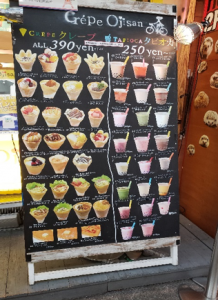
A Crêpe shop in Kyoto

Yet that is one of the main reasons that I am glad for this experience. Because through it I have really learned the difference between “visiting” and “living” in a different country. When you visit a place, you only experience the brief initial culture shock and then the honeymoon period. You figure out how to get around, visit all the nice tourist spots and then return home before the high wears off.

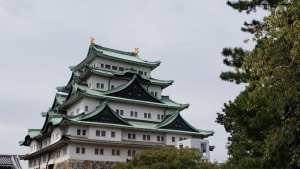
Nagoya Castle

Living is very different. Things that were once exotic and exciting become mundane, typical parts of life, and much of the excitement disappears. However, in a country like Japan which is drastically different than America, things may become “less exciting” but it never feels *completely normal. I may know the streets of Hirakata now, but it still feels alien in a sense. It is a little unsettling, the feeling that you now belong in a place, but not really.

Nagoya’s Toyota museum

I think some of this is exacerbated by the fact that more so then ever before, I really feel like I am on the clock. After all, I have four months of an opportunity many people never get in their entire lives. Additionally, people who know me well can attest that I often feel as if I am not doing enough – and this feeling is certainly being amplified here.

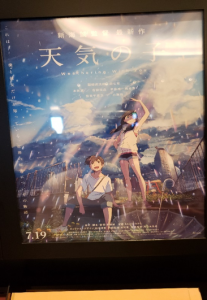
I saw the movie “Weathering with You” (天気の子)

Me getting ready for KGU’s “open campus”

To cap off my first month, I have further explored Osaka and Kyoto. I went on a tour to Nagoya and visited some of its most well-known historical sites. I have become a semi-regular at two bars. I volunteered at a campus open house. I saw a movie in Japanese theatres for the first time. For October, I plan to visit Nara, Kobe, Hirakata Park and possibly Tokyo, while going to places in Osaka and Kyoto that I still have not seen. (They are huge cities) Hiroshima and Universal Studios are also on the agenda. There is a lot to be excited about, but it is important to remember that study abroad, while amazing in so many ways, is not a magic bullet for your problems and that there will be ups and downs no matter where you are.

A Day in Reutlingen

Author: Elisabeth Walters

Location: Reutlingen, Germany

Pronouns: She/Her/Hers

When choosing a place to study abroad, one of the aspects I considered was which location provided more opportunities to travel and observe different cultures. For me, Reutlingen provided easier access for my desires, however; I never imagined the amble amount of experiences that the location itself contained. Within just one day this city has provided me with an experience that cannot be found in any other study abroad location.

When starting off my day in Reutlingen, I walked around the campus and local streets. While doing this activity, I realized the calming atmosphere of the city as well as its unique beauty compared to where I call home. Also, when choosing to walk, I got to closely observe the true culture of the country and city, in which I witnessed to be true to staying both healthy and active.

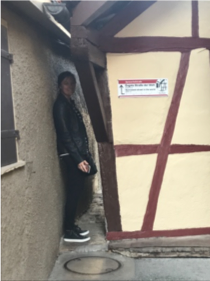
After enjoying my morning and early afternoon, the Valpo group met with the program’s Resident Director, who is thrilled to show our group the true culture of the country. After the meeting, we headed to downtown Reutlingen with the Resident Director to see specific sites and visit the city’s Weindorf (wine fest). Before visiting Weindorf, the group visited the narrowest street in the world, which is in downtown Reutlingen as well as the Marienkirche (St. Mary’s Church).

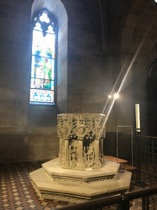
The Marienkirche, which was built between 1247 and 1343, is one of the most Gothic buildings in Swabia (the region in which Reutlingen is in). When inside the Marienkirche one can easily depict the differences between American and European culture, not only through the architecture, but the furniture within the church.

Baptismal Fount inside the Marienkirche

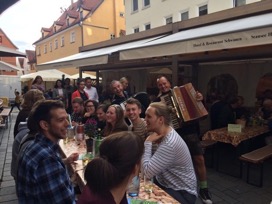
Once we explored the downtown area a little bit, we continued onto Weindorf, where the cultural experience did not stop. While at Weindorf, our group enjoyed different types of wines and enjoyed the music provided by two talented accordion players. While sitting in the streets of downtown Reutlingen I could not help but enjoy the fun and exciting new atmosphere.

At the end of the night, we were able to choose where we wished to go. Although we were allowed to separate, the whole group decided to visit the Irish Pub and there we met other international students who are studying in Reutlingen as well this semester. Through this meeting, we got to witness a mixture of cultures as well as develop new friendships.

Overall, the lesson learned was that one can always find culture and unique experiences within the city they are staying in. Also, that the program in Reutlingen has more to offer than what meets the eye.

Studying in Japan-What it means to me/early reflections

Author: Brandon Polinski

Location: Hirakata, Osaka, and Kyoto, Japan

Pronouns: He/Him/His

A lot of people in my life don’t realize this, aside from some of my closer friends, but I have had a bit of a rough year. While I made some incredible breakthroughs in both my professional and personal development, at the same time I came to realize how flawed and lacking I am in other areas, and how much further I still need to go in order to become the person I strive to be. I won’t deny I spent a decent portion of the summer trying (and not always succeeding) in putting myself back together after taking some hard knocks last semester. On the upside, I had a fantastic internship over the summer, and once that was completed it was with great anticipation and anxiety that I embarked on my first time traveling outside of the United States independently. Living in Japan has been my dream for the past five years, which is why I chose this specific program.

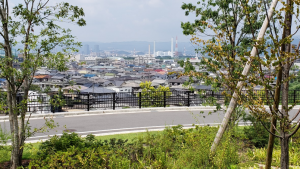
Hirakata-Shi, my current place of residence.

So far it has been fantastic. Having this study abroad has restored my sense of order and purpose while giving me hope for the future. It is also going to be the last semester of my undergraduate, so it also feels like a second chance at having the semester I wanted (but failed to attain) last spring. I would like to use this initial post to organize some general thoughts and observations over these first two weeks as I begin to get more settled in and integrated with my surroundings.

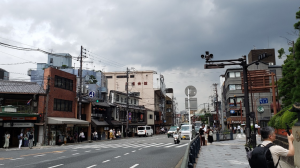
A street in Kyoto.

The first thing I would like to mention is that even broken Japanese and basic reading ability, when supplemented *appropriately* with English – goes very, very far here. I had always heard this but experiencing it for myself really drove it home. Quite a few international students at Kansai Gaidai came with almost no Japanese language or reading skills and they have certainly struggled in some areas. However, I have found that with my current level of proficiency (which I thought was not great) I have been able to do almost everything I have wanted to do with confidence. Ordering food, riding public transportation, quickly finding what I need at a convenience store, and even registering my change in address with the city hall, has not been difficult.

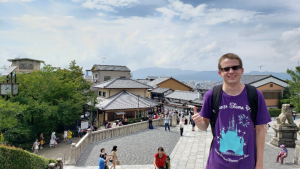
Me in Kyoto.

My language speaking partner and myself.

Additionally, I have found residential life to be extremely fulfilling. I was torn between living on campus or with a Japanese family, but I have found my current living arrangements on campus to be the best choice for me. I live with roughly 300 other international students (plus 300 Japanese), and about 200 of the international students are from either the U.S or Canada. Being in the middle of Japan, I of course encounter and need to utilize Japanese now on a constant basis. Improving my Japanese is something I no longer worry about. Kansai Gaidai may be an international bubble of sorts, but walk a short distance out of the gate and you quickly become a very, very, small minority in which attempting to rely on just English will limit you a good deal. However, living with what is probably the largest native English-speaking community in the Kansai region helps set me at ease when I am exhausted from using a lot of Japanese and reminds me that I am far from alone here. Students also had the option of applying for a language partner. The idea is that they will help you with your Japanese, and you can help them get even better at English. All these things combined act as an overall great support network, one just needs to be willing to seek them out.

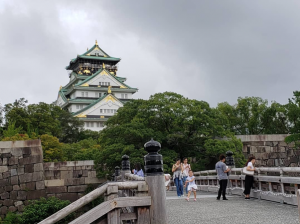
Osaka Castle

Overall, I look forward to the coming weeks and months ahead. So far, I have been on multiple trips to Osaka (public transportation is amazing here), went on a Kyoto tour, and have familiarized myself with much of Hirakata-Shi. Classes have just started for the Asian Studies program, a week ahead of everyone else. As far as academics go, this is will be the easiest semester I have had in a very long time. I plan on using that extra time to network, travel, and all around get as much out of this experience as possible.

Outback Excursions

Author: Sarah Buckman

Location: Outback, Australia

Pronouns: She/Her/Hers

There are many trips I have been blessed enough to experience while studying abroad in Australia, but one of my favorites would have to be the time a couple of my friends and I road tripped to the outback. A beautiful opportunity to explore the nature that takes up so much of this country.

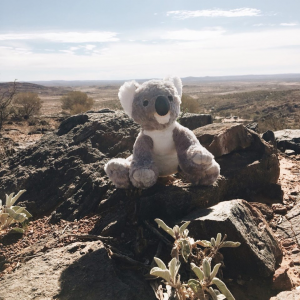
Our honorary mascot of the trip- Kenny the Koala!

In total, my friends and I spent roughly 38 hours in the Outback—26 of which was driving to and from. It was one of the most jam packed road trips I have ever been on, and I have never been so thankful we were able to do it. After picking up our car from the rental place, we had 13 hours of open road ahead of us, but boy was it full of so much adventure. Once out of the major towns, the amount of wildlife we saw was crazy. Hundreds of kangaroos, dozens of goats and a couple of smaller creatures tried to find their way across the road while we were driving throughout the day which helped keep us awake and alert. There were a couple of close calls, but we are happy to say that any animal that crossed our paths made it to the other side!

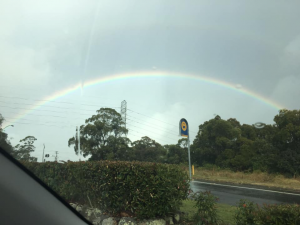
On our way to the Outback- this huge rainbow decided to make an appearance!

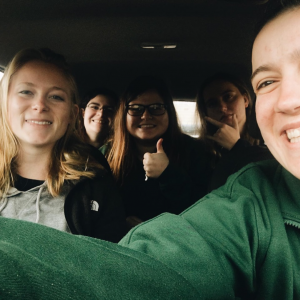
Road Trip!! (Featuring Sara, Mary, Alexis, Jamie and myself!)

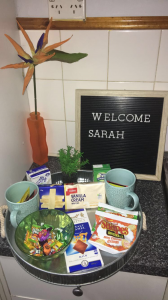
We rented a room for the first night we were there which was the perfect way to rest up for the big day we were going to have the following day. Since the outback is home to mostly animals, and not many people, you are definitely able to find cheap places to stay which helps on a budget. The place we stayed at threw in snacks as well as movies and games for us to do. So we all gathered around the couch and made our night that much more eventful by watching movies.

The place we stayed at set this out for us and so much more! Australian people love to treat Americans right!

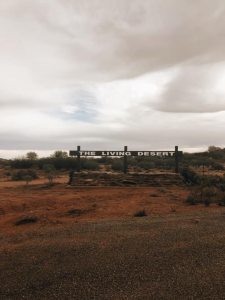
The next day we woke up bright and early so we could spend as much time in the Outback as we could. So, we drove to the Living Desert Park to see some wildlife and statues. If you want to spend a full day in the Outback while on a budget, I could not recommend going to their national parks more. If you have the money, I’ve heard tours through the Outback are also incredible. Anyhow, we pulled in and immediately saw some wild kangaroos- not just the ones you find at every zoo in Australia- actual live, wild ones. Can you get any more Australian? We spent the first half of our day looking at these huge rock sculptures inspired by their culture. Then after a quick lunch we spent the next half just hiking on a trail. Throughout the day we saw even more wild kangaroos and some wildflowers and fruits! We then had a long drive ahead of us but decided to drive off the park grounds and pull over to watch the sunset! We seriously wanted to take the most advantage of the natural beauty as we could. We loved it so much, we stayed, and star gazed for a while too. Fair warning in advance- if you pull over to the side of the road in Australia, you will have many Australians stopping to make sure you’re okay because they’re so nice!

The welcome sign to the park!

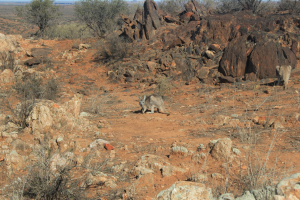
Spotted wild kangaroo!

Wild kangaroos blend in so well with their environment!

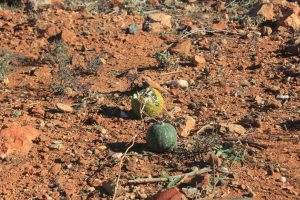
Wild fruit in the Outback! We think a Kangaroo must have had some for lunch!

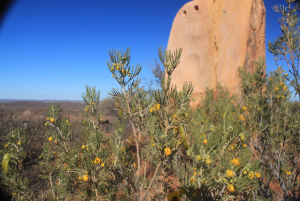
Some wildflowers we saw throughout the Outback!

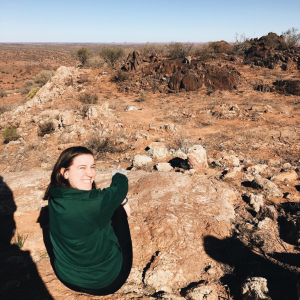
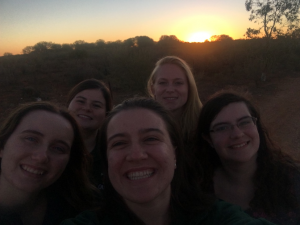
Outback selfie with the gals!

Overall, this trip ended up being the perfect way to wrap up my study abroad trip in Australia. If I were to give you one piece of advice after going on that trip, it would be to make sure to plan a final excursion for yourself while on your study abroad program as well. I heard tons of advice before leaving for my program- to make sure to plan excursions- but no one ever told me how much more meaningful they are to you at the end of your trip. Trust me, it helps you appreciate the country you’ve been in for so long- even that much more.

Back to Santa Rosa

Author: Sarah Germann

Location: Santa Rosa de Santo Domingo de Heredia, Costa Rica

Pronouns: She/Her/Hers

After staying in Limón for a month I returned to my original host family in Santa Rosa for a few weeks before the end of the semester. The culture in Limón and that in Santa Rosa are a little different. The family I was staying with in Limón was a rural family, they did not socialize as much as my family in Santa Rosa, and they used the Spanish language differently. This made it harder for me to communicate, and take longer for me to feel at home in Limón than I had expected.

I had assumed I would feel relief once I returned from rural Limón to the more familiar and suburban Santa Rosa because I would be in a more urban environment. But, what really stuck out to me was the amount of affection I received the first few days of being back. I felt welcomed back into the entire community, first by my host family, and then many others; friends from Frisbee, the other Valpo students, families and young adults who live at Casa Adobe (the house where we take classes), and the other students in the Field Biology program with ICADS. After returning from Limón, it became clear just how many different groups of people I had gotten to know and become a part of in the San Jose and Santa Rosa area during the first couple of months of my semester.

During my last couple weeks staying in Santa Rosa I became much more comfortable in the area. I am not sure if I felt more comfortable because I had grown more use to the culture of Costa Rica during the month of April when I was in Limón, or if I had missed Santa Rosa while I was away. For whatever reason, I felt as if there was a click in those last couple of weeks, as if I had taken on the country’s culture and it had become more natural to me. I greeted people in a typical Costa Rican manner without thinking too hard about it, I rode the train and traveled around with much more ease, and I found the rhythm of life to be more comfortably familiar. It became my home, because I had adjusted. Speaking Spanish also became much easier in the last couple of weeks in Costa Rica. Again, it was as if there was a click in my brain and I could understand much more and speak more fluidly so that I could more easily enjoy conversations and social gatherings. I was greatly pleased with this change in myself particularly because of how far I had come since the beginning of the semester, when I had been shy and uncertain of almost every action I took and had found it very difficult to understand or speak the language.

My integration into the community of Santa Rosa made leaving harder. The people there are very warm and friendly, and have a life style centered around family and friends. However, it was proven to me that it is possible to become a part of another community and make friends rather quickly, even when there is a language barrier. I am encouraged to lean into my community, by getting to know and spend time with people as well as paying attention to the needs of others living in the area around me, when I return to my home in Valparaiso.

Some women of Santa Rosa, from left to right; Erin (Casa Adobe, Ivannia’s former host student), Lydia (Valpo student), Ivannia (Lydia’s host mom), Iva (my host mom), myself, and Teresa (sitting in front, Casa Adobe)

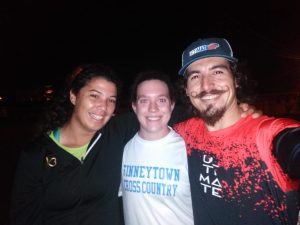
Nicole (left), Paul (right) and myself (center). The three of us all lived in Santa Rosa and played Ultimate Frisbee. We would ride to practice and team gatherings together in Paul’s car, and they became some really close friends of mine.

Breathtaking Beaches in Australia

Author: Sarah Buckman

Location: Newcastle, Australia
Pronouns: She/Her/Hers

Australia is notoriously known for having numerous beaches, all with different aspects worth exploring. So how do you decide which to visit? If you’re anything like me, you love spending a day at the beach more than anything and recognize they are all unique in their own way. Lucky for you, I have been blessed to visit many different beaches here and thought I would give you the insider scoop on what each one has to offer!

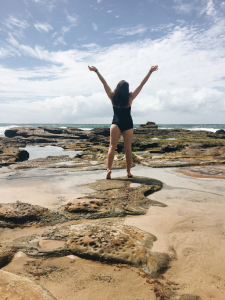
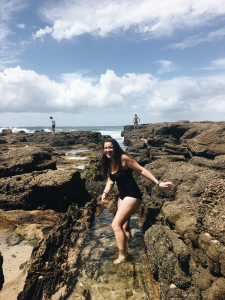
Picture of me enjoying Australia’s beautiful weather

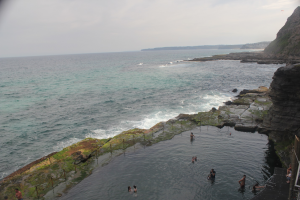
The first one is Newcastle Beach, which is one of the closest beaches to the Newcastle City Campus. It is only like a 20-minute walk through downtown and is a staple for most students who go to the University of Newcastle. Since Australia has incredible weather for almost all of their first semester, you will find most students on their days off, or after class hanging at the beach. The nearby area is very high-end, featuring hotels and restaurants, but you can still find some relatively cheap eats nearby! Newcastle beach also features a separate pool, full of seawater, that is perfect for a swim. A bonus sight that is a must-see is the Bogey Hole! Once you get to the Newcastle beach, it is only a half hour hike from there. It’s a gorgeous hike that allows you to see a great aerial view of the ocean, as well as the flora and fauna.

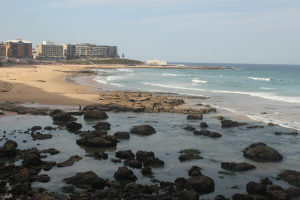
Newcastle Beach

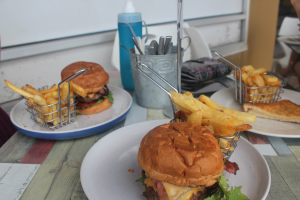
My friends and I grabbing some delicious burgers and chips at Newcastle Beach

The Bogey Hole

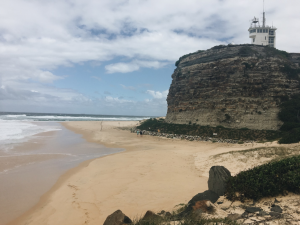
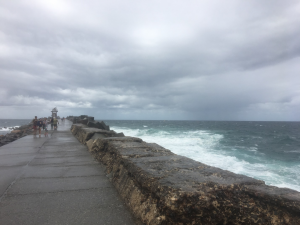
Another beach that is worth spending a day at is Nobbys Beach. From first glance it may not seem as interesting as the other ones listed, but it does not make it any less special. Nobbys has a fairly flat landscape compared to the other ones, making it perfect for a chill kind of day. Due to this kind of landscape, it’s a great place to go if you like to swim without the intense waves. After you have had your fill of relaxing, one of Nobbys best features is the Nobbys Lighthouse and Breakwall. After about a half hour walk you will find the lighthouse on top of the hill and then there is a breakwall that stretches on for another 20 minutes. Fair warning in advance, the breakwall gets slippery due to the huge waves that crash against it! So worth seeing.

Nobbys Lighthouse

Nobbys Breakwall

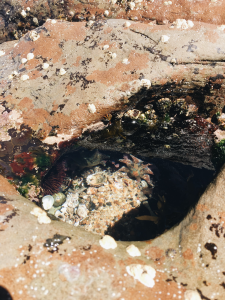
Bar Beach is the next stop that is a must see for its natural beauty. It is a long beach, featuring tall rock features in the landscape. This is also the first beach that I visited and noticed Australia’s trend in having little pockets full of water that deserve a closer look! In some of these water pockets you will find them full of small fish, starfish, and some even have crabs. They are the coolest things to observe, and they alone are worth going to see. I saw not only starfish but even a couple of sea urchins! It was the most surreal moment to see them outside of an aquarium setting. Just another great beach to see purely for its unique landscape features. Once you have had your fill of nature, feel free to fill up on some hot grub! Bar beach is not only unique nature-wise, but also unique in its way of having some cute little stands to get some food from. This is, without a doubt, another beach worth seeing.

One of the many water pockets you can find on the rocks! If you look closely, you will see this one features some starfish and a sea urchin!

Now, if you want to see a beach in Australia that truly displays unique natural beauty, the one to go to is Caves Beach. As you can probably tell by the name, this beach does in fact have caves on it! They are big enough to explore and are so worth seeing! This beach also just has an abundance of rocks to climb on or swim around, making it an all-around exciting and adventurous kind of day. A bonus to this beach is the surfing! If you love to surf, or are interested in learning, this is the perfect beach to do it at! I went with our group of international students here to take a lesson and we had a blast! If you love to laugh at yourself, this is the perfect thing to try out. Overall, a fun filled day you will not regret.

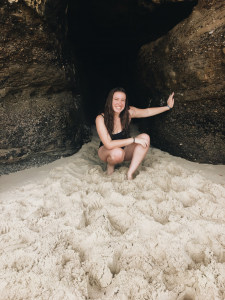
Me exploring the caves at Caves Beach!

Playing around the rocks at Caves Beach!

Lastly, and probably the most well-known, Bondi Beach is a non-negotiable in the list of Australian Beaches to see. Yes, this beach is in fact the one featured in the show Bondi Rescue- so pro tip: if you are going to Bondi Beach, be prepared to tell everyone you know “yes this IS the beach from that show”, etc. because you will get asked about it greatly. Besides the fact, it too is a must-see place for its own reasons. There are plenty of cute touristy shops to hit up downtown as well as fantastic eats. The beach is also known for its street art that is ideal for pictures. If you enjoy skateboarding, be prepared to shred too! The skate park there is a popular place to hang at. Nature wise, besides the gorgeous shoreline, includes a hike to Mackenzies Point that is absolutely stunning to see at sunset. On the way there you will pass the Bondi Icebergs Pool which is another Bondi trip must. If you visit this beach, you will definitely want to make sure you set aside the whole day to experience it all.

The far end of Bondi Beach

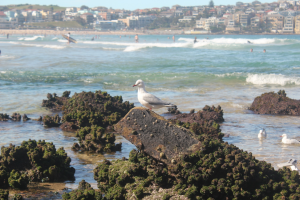
Bondi Beach is home to many creatures, including dozens of birds!

Of course, these are just my top 5 recommendations to visit while you are in Australia. This only scratches the surface to the amount of beaches they have here! Every beach will give you a different experience that helps captivate the Australian culture. With every beach trip I take while I’ve been in Australia, it has shown me the beauty in finding times to relax throughout your study abroad trip—a very underrated thing every student that studies abroad should learn how to do!

Panama Trip

Author: Sarah Germann

Location: Changuinola, Panama and Nazo Indigenous Community, Panama

Pronoun: She/Her/Hers

The other Valpo student and I traveled to Costa Rica under tourist status, meaning that after 90 days in the country we needed to leave Costa Rica to renew our visas. Thus, in mid-April, we went on a trip to Panama!

There were a couple subtle differences I noticed between Costa Rica and Panama. First, after two days, I noticed that handshakes were normal. At first I thought I was receiving handshakes because the people there knew I was from the United States, trying to be welcoming. But, I received only handshakes and was never offered a kiss on the cheek. I may have imagined it, but the handshakes did seem a little firmer and more practiced than the ones I have received in Costa Rica. A clarifying question to our guide confirmed that handshakes are the normal form of greeting in Panama. The handshake is probably due to the influence of the United States in their country.

Another thing I saw in Panama which may have been influenced by the United States was the military base near the Nazo indigenous community. The buildings in the base were painted with the same brown and green army pattern as I have seen used in the United States. We were told that the soldiers in training were brought to that point, where they learn jungle survival in order to outlive their opponents. There was a platform where the soldiers could face a flag and salute. Embarrassingly, when I first saw the painted buildings I thought the camp was originally a US training camp. It very much resembled a United States style military training camp. I cannot help but think there must have been some really heavy US influence there. By contrast, Costa Rica is a very peaceful country, and basically lacks a military.

In a way, the similarities between the US and Panama made me feel just a little more at home in Panama than I did in Costa Rica. Though there were only very minor differences, having more cultural similarities can make a person more comfortable in an area though they are very far from their original country. This, obviously, applies even when there is a language barrier, as I had the same challenge of understanding Spanish in both Costa Rica and Panama. The realization that even small similarities between a foreign culture and home country can facilitate ease during transition and comfort brings up a number of questions. I would be interested to see if I would be more comfortable in a different culture which speaks English.

My experience in Panama compared to that in Costa Rica serves to highlight the fact that our cultural norms, such as common greetings, is instilled in us so that when our norms are followed we feel “normal” and when we are not used to the norms, we feel strange. From now on I should have a greater appreciation and awareness for people who are new to my own country.

Our boat ride to the military base in the Nazo Indigenous Community

A boat on the beach in the Nazo Indigenous Community.

Getting Involved While Abroad

Author: Sarah Buckman

Location: Newcastle, Australia
Pronouns: She/Her/Hers

Everyone has their daily routines. At college this most likely includes the many jobs, clubs, and activities you find yourself involved in. However, this tends to happen naturally, while in your home country. So how do you get involved while abroad? Here I will share some of the things I did to get involved while abroad, that ultimately changed my entire experience for the better.

Some international students and I at Vivid Lights in Sydney!

When you get to your country that you will be abroad in, the first thing I recommend as a must do would be to take advantage of your new college’s welcome week. It is typically within the first week of you arriving there and is jam packed with optional activities to go to. Make it your personal mission to go to as many things you find interesting as possible! What better way to get your feet wet than by taking advantage of how new everyone is to college life, to meet people, join things, and make memories! Between tours, get togethers, club and sport meet and greets, and activity fairs there is so much offered during this unique week. Out of all the things listed, if I were to pick the top thing that changed my experience would be the activities fair. If you can only make it to one thing be sure to make it to this! Even though you will feel like a freshman all over again, it is something that should not be passed up in order to get involved and acclimated to your new college.

____________________________________________________________________________________________

While at the activities fair, make sure to be open to trying new things, but also make sure to get to the booths you know are things you will most likely get involved with. For myself, I love to be involved religiously, so I made sure to get information from those. If you are also interested in spirituality while abroad, you are in for some good news! It is very likely no matter where you end up studying that there will be plenty of options for you! I love getting involved in the Chapel back at Valparaiso University, so I knew this would be a good fit for me! Turned out, between UniChurch and Reality Bible Study at the University of Newcastle, both are where I ended up making the majority of my friends while abroad! I hung out with these friends almost every day, go on day trips with them, and even went on a weekend retreat with them! Such a unique experience to have during a study abroad program! I even became a volunteer youth leader while I was abroad and got to work with kids! Could not recommend this bit of advice enough!

Some of my friends and I during our weekend retreat!

One very easy thing to help you get involved on your new campus is to check to see if your campus offers an international student club/organization. At the University of Newcastle, our international organization was called UNESN (University of Newcastle Exchange Student Network) and it was a fantastic resource to meet people from many different countries besides America and Australia. Through this organization, I had the opportunity to go on many excursions and planned events and got to meet many people and grow close to those people because we all looked forward to seeing each other again on the next event. Going abroad is about meeting people from new places and being a part of an international organization helps this piece of studying abroad become a reality.

UNESN group on our trip to the Blue Mountains!

Another solid way to get involved while abroad is to attend building and/or floor activities! Just like in America, you will find most colleges will still offer events that are just related to the people you live closest to! In my case, my dorm building not only hosted building events, but even floor ones. Making sure to go to them when you have the time is a great way to meet even more people, and it does not require any work! During my floor events we played games, made baked goods for each other and even potted plants together. Each event probably only lasted an hour, but it still made the best impact at getting to know people better. As far as building events go, there are too many to recount! My favorite, and most impactful one that I went on, by far, was when we all went to clean the beach on National Clean Up Australia Day! It was so cool getting together with them to accomplish something that held a bigger impact than just on ourselves. Seriously, take advantage of getting to know the people who are literally closest to you!
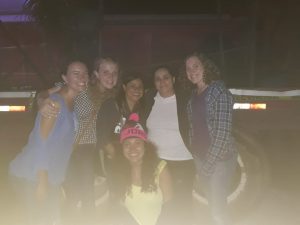
Cleaning up the beach with my fellow dorm-building mates!

These are just a couple of ways to help get you involved while abroad. If studying abroad has taught me anything, it is that the more people you meet, the better your experience will become. Why seclude yourself to small amounts of people when clearly studying abroad shows you just how big the world can be? Do not be afraid to branch out and to put yourself out there!

Why should you study abroad in Viña del Mar, Chile?

Author: Casey Bremer

Location: Viña del Mar, Chile

Pronouns: She/Her/Hers

As I reflect on my past semester in Chile, I think about all of the amazing people I met, the unforgettable moments, and the many life lessons I have learned in the past 4 months. But before this semester, I was actually uncertain about spending my semester abroad in Chile. I was considering studying in Zaragoza, Spain or Puebla, Mexico instead, and was doubting my final decision to go to South America. But now, looking back, I can’t believe I was second-guessing myself. Studying abroad in Viña del Mar was, without a doubt, one of the best decisions of my life. I can’t stop talking about Chile, and all of the love I felt there, and I want everyone to experience this amazing country! I think other Valparaiso University students would really benefit from this experience, even though it might not be as iconic or well-known as other semester destinations, like Cambridge or other European programs. Chile has without a doubt become my favorite place in the world, and I just want other people to love the South American country as much as I do. So, in no particular order, here are some of the top reasons why other students should study abroad in Viña del Mar, Chile.

  • The UVM International Club: The University of Vina del Mar is really special. Not only are the courses really enlightening, but the social aspect is incredible. I’ve never seen a university that is so accommodating to international exchange students. They have a really well-developed International Club, in which 50 Chilean students organize events and outings for about 100 international students. Every Chilean that I met through this club greeted me with nothing but kindness and eagerness to teach me about their culture and country. In addition, this club was a great way to learn about other countries. Every few weeks, we would organize special events to learn more about other students’ home countries. So we had days about Mexico, France, Finland, Peru, and various others. Every time the club got together, it was so much fun and by the end of the semester, we were like a little family and super sad to leave each other.

  • Cultural Exchange: Because of the International Club, I got to know people from all around the world, not just from Chile. Some of my best friends from the semester were from France, Germany, and Mexico. So I ended up learning about their cultures as well, and we spent a lot of time discussing the differences and similarities between our home countries. For example, I spent a lot of time with a boy, Paul, and a girl, Fanny, both from Paris, France. It was really interesting to hear about their experiences in Europe, and I feel like I learned a lot about French culture just from hanging out with them. Plus, they taught me some really good French slang for when I visit them in Paris!

  • Language Skills: Since not very many people in Chile speak English (mostly just the younger generation), you’ll get to practice Spanish daily and your language abilities will improve so much! I had a friend from Germany, Laura, who arrived in Chile and spoke absolutely no Spanish. But by the time she left, just 4 months later, she had reached level B1 and was speaking really well. Overall, Chile is a great place to practice your language skills, simply because you have no choice but to practice every day. And every Chilean that I met was more than happy to teach me something new or explain something that I didn’t understand.
  • The People: You will meet so many great people and form amazing friendships! By the time your semester ends, you will feel like you have a family in Chile. In all of my travels, I have never met kinder, warmer people than the people I have met in Chile. They go out of their way to make sure you are taken care of and happy. In addition, they understand that you might not be fluent in Spanish, and are always willing to help explain an unfamiliar word. The Chileans I met also seemed to love the fact that exchange students come to their country, and they love sharing their culture. Throughout the semester we celebrated birthdays together, traveled together, and formed really strong friendships. Before I left they wrote me letters, gave me gifts, and went out of their way to spend time with me- just to make sure that I knew how much they loved me and would miss me. They are one of the main reasons why I love Chile so much.

  • Nature: If you like nature, then Chile is the perfect choice for you. As the longest country in the world, Chile has countless places to visit, with so much diversity in the landscape. From the driest desert in the world in the north (Atacama) to one of the most beautiful mountain ranges in the south (Patagonia), there are so many varieties of places to visit! Plus, with 2,653 miles of coast, you will have endless beaches to visit. My friends and I loved just sitting on the beach in Viña, watching the sunset. Almost every day, the views were beautiful with constantly changing colors. I wholeheartedly believe that Chile has the best sunsets in the world.

  • Personal Development: You will become so much more confident. Studying in a different country, learning a new language, being independent, and meeting so many new people- all of this helps your confidence immensely. After 4 months, you might not even recognize yourself! I never would have imagined how much I could change throughout the semester. I went from being more shy and introverted in the start of the semester, to actually performing a dance and presenting awards (in Spanish!) in front of 100 people at the university’s goodbye dinner at the end of the semester! I can credit this personal change to nothing but living abroad and knowing I can survive (and thrive) in Chile.

Overall, despite some initial doubts, studying in Viña del Mar was one of the best choices that I could have made. I met so many incredible people, saw unforgettable landscapes, improved my Spanish skills immensely, learned a lot about other parts of the world, and became a much more confident person. Because of this, I really recommend Viña del Mar to every student who is even considering a study abroad program. It was the best semester of my life, and it’s been a pleasure blogging about it and sharing my experiences. Thanks for reading!

« Older posts Newer posts »

© 2026 Valpo Voyager

Theme by Anders NorenUp ↑